Racism Between the Goal Posts
Share
Explore Our Galleries









Breaking News!
Today's news and culture by Black and other reporters in the Black and mainstream media.
Ways to Support ABHM?
By Tom Jacobs, Pacific Standard
“Black people aren’t allowed to make mistakes,” Prince declared last year, in a statement that spoke for many. Screw up once, the thinking goes, and you’re out, having confirmed the view of many whites that you didn’t deserve a shot in the first place.
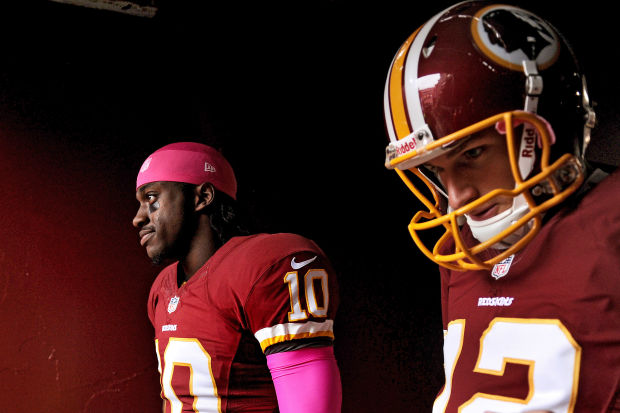
Washington Redskins quarterbacks Robert Griffin III (L) and Kirk Cousins.
New research provides evidence of that destructive dynamic on one of America’s largest stages: the National Football League.
A new study concludes that black NFL quarterbacks are roughly twice as likely to be benched the following week than their white colleagues.*
After taking a series of variables into account (including age, experience, and injury), Assumption College economist Brian Volz found a pattern of player replacement that suggests systematic racial discrimination. He also reports that, in terms of on-field performance, teams pay a price for this behavior.
Writing in the Journal of Sports Economics, Volz begins by noting that, over the last 13 seasons, the percentage of African-American starting quarterbacks ranged from 16 to 28 percent—startlingly low numbers, considering that about two-thirds of NFL players are black.
To determine whether this reflects racial discrimination, he analyzed data from 2001 to 2009, looking specifically at quarterbacks who started the first game of the season. (He reasoned that those whose first game as a starter come later in the season may simply be replacing an injured or otherwise indisposed player.)
He then took into account a number of non-racial factors that could influence a quarterback being benched, including his age, experience, and performance; the quality of the second-string quarterback who replaced him; and of course any injuries he had sustained. In addition, he looked at the percentage of black residents in a team’s metropolitan area, to see if the racial make-up of the fan base had an impact on the decision.
Volz found that, once all the variables were factored in, “black starting quarterbacks are 1.98 to 2.46 times more likely to be benched the next week” than white quarterbacks with approximately equivalent skills. “This implies that black quarterbacks may face some level of discrimination in the NFL,” he writes…
The results suggest some whites feel a degree of discomfort seeing an African American in an on-field leadership role, and this puts pressure on black quarterbacks to produce quickly or be replaced. Whether the coaches and team owners are responding in a personally racist way, or believe they are reflecting the perceived preferences of the fans, is not clear. But either is equally indefensible.
Given the fact professional football is dealing with a lot of problems at the moment, one hesitates to pile on. But this pernicious pattern needs to be examined, and the discrimination it reveals should be ruled out of bounds.
Read the full article here.
Read more Breaking News here.
Comments Are Welcome
Note: We moderate submissions in order to create a space for meaningful dialogue, a space where museum visitors – adults and youth –– can exchange informed, thoughtful, and relevant comments that add value to our exhibits.
Racial slurs, personal attacks, obscenity, profanity, and SHOUTING do not meet the above standard. Such comments are posted in the exhibit Hateful Speech. Commercial promotions, impersonations, and incoherent comments likewise fail to meet our goals, so will not be posted. Submissions longer than 120 words will be shortened.
See our full Comments Policy here.