Racial Terror and the Second Repeal of Reconstruction
Share
Explore Our Galleries









Breaking News!
Today's news and culture by Black and other reporters in the Black and mainstream media.
Ways to Support ABHM?
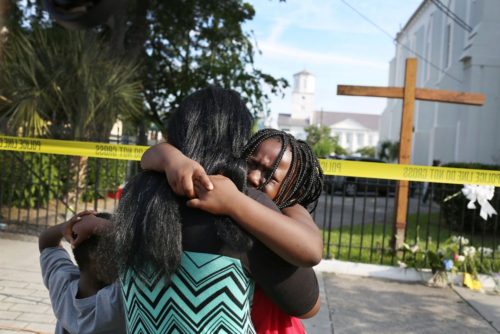
Kearston Farr comforts her daughter, Taliyah, outside the Charleston, South Carolina, church where Dylann Roof killed nine people. Joe Raedle/Getty
How the legacy of Jim Crow haunts Trump’s America
By Kimberle Williams Crenshaw, newrepublic.com
This April, PBS aired a groundbreaking documentary series on the fate of Reconstruction—and therefore of Black America. Featuring more than 40 scholars (myself among them) and Black descendants of key figures in Reconstruction’s history, this copiously researched chronicle also doubles as a powerful and chilling window on to our own age of violent and resurgent white nationalism. With nuanced commentaries about the rise and fall of Reconstruction, the series revealed how African Americans—in the words of W.E.B. Du Bois—emerged from bondage, and stood briefly in the sun before being returned to the unyielding weight of white supremacy.
The repudiation of Reconstruction’s initial promise was launched in shockingly brutal fashion, via a burgeoning series of massacres and lynchings, carried out by white vigilantes and law enforcement officials alike against Black people. As Southern Redeemers worked to put down burgeoning alliances between Blacks and whites—a coalition that foreshadowed precisely the class-based politics now rhetorically championed by left and liberal critics of “identity politics”—Black bodies served as the scapegoats; their ritual sacrifice permitted postbellum whites to reunite across class and region.
This vicious scourge of lynchings and mass killings was perhaps the decisive factor in reducing Black representation to nothing by the early part of the twentieth century. It’s important to note, though, that like all concerted denials of Black civil and political rights, this campaign was not inevitable. Had the Supreme Court not hamstrung the federal government from protecting its citizens from massive violence, effectively nullifying the transformative possibilities of the Civil War, the white supremacist hold on national politics might have given way to a far more robust vision of democratic pluralism. But radical Republicans lacked the raw political power to triumph over an ideology of white supremacy that shaped the foundations of our federal Constitution. ..
Read the full article here
More about Reconstruction here
View more ABHM galleries here
Comments Are Welcome
Note: We moderate submissions in order to create a space for meaningful dialogue, a space where museum visitors – adults and youth –– can exchange informed, thoughtful, and relevant comments that add value to our exhibits.
Racial slurs, personal attacks, obscenity, profanity, and SHOUTING do not meet the above standard. Such comments are posted in the exhibit Hateful Speech. Commercial promotions, impersonations, and incoherent comments likewise fail to meet our goals, so will not be posted. Submissions longer than 120 words will be shortened.
See our full Comments Policy here.