Obama at Morehouse: Try Another Listen
Share
Explore Our Galleries









Breaking News!
Today's news and culture by Black and other reporters in the Black and mainstream media.
Ways to Support ABHM?
By Jack White, theRoot
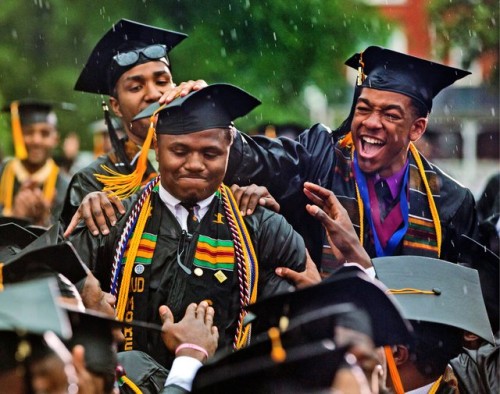
You might find that attacks on his commencement speech — a hit among graduates — missed the mark.
It’s been evident since Obama’s first election that America was dividing into two different worlds, broadly defined by demographics. He was swept into office by a relatively youthful, ethnically diverse coalition in which huge majorities of blacks and Hispanics were allied with a minority of whites. His opponents consisted mainly of older whites unsettled by the emergence of a new America. These were people, as I wrote some years ago, who “went to sleep in their America on Election Day 2008 and woke up in another country, as though they had been swept up in a spaceship and transported to an alien world.”
But now, if we can judge by the disagreement between highbrows such as Coates and Capehart, a similar disjunction may be starting to develop in some rarefied
segments of black America. Obama’s conservative white critics twist his every word and action into further proof that he is a socialist, crypto-Muslim bent on destroying the country. In much the same way, his emerging cadre of black, usually leftish, critics interpret his every move as evidence that he is a pro-establishment cynic using his speeches to black folks to send coded “Sister Souljah” speech messages to white folks. They’re determined to find fault with Obama even when he does something right — and in this case at least, they are as out of touch as the president’s right-wing opponents.
That’s the conclusion I reached after rereading Obama’s Morehouse remarks in light of the strong critiques from Coates and Kai Wright, my esteemed former colleague at The Root. I didn’t hear the “convenient race talk” that Coates detected or the browbeating that troubled Wright. I didn’t even hear the voice of a politician.
I heard the voice of my father.
It could have been my dad lecturing me across the dinner table when Obama declared, “You have to work twice as hard as anyone else if you want to get by.”
And again, when he admonished the graduates to “be a good role model, set a good example for that young brother coming up. If you know somebody who’s not on point, go back and bring that brother along. Those who’ve been left behind, who haven’t had the same opportunities we have — they need to hear from you.”
And yet again, when he urged them to “recognize the burdens you carry with you, but to resist the temptation to use them as excuses. To transform the way we think about manhood, and set higher standards for ourselves and for others. To be successful, but also to understand that each of us has responsibilities not just to ourselves, but to one another and to future generations. Men who refuse to be afraid. Men who refuse to be afraid.”
Those are the messages that my father, a medical-school professor at Howard University who died 25 years ago, pounded into my head as I was growing up, and that I’ve tried to convey to my own children.
Read the full article and the description of the debate about the speech here.
Read more Breaking News here.
Comments Are Welcome
Note: We moderate submissions in order to create a space for meaningful dialogue, a space where museum visitors – adults and youth –– can exchange informed, thoughtful, and relevant comments that add value to our exhibits.
Racial slurs, personal attacks, obscenity, profanity, and SHOUTING do not meet the above standard. Such comments are posted in the exhibit Hateful Speech. Commercial promotions, impersonations, and incoherent comments likewise fail to meet our goals, so will not be posted. Submissions longer than 120 words will be shortened.
See our full Comments Policy here.