New Malcolm X Diary Reveals a Revolutionary Optimist
Share
Explore Our Galleries









Breaking News!
Today's news and culture by Black and other reporters in the Black and mainstream media.
Ways to Support ABHM?
By Todd Steven Burroughs, The Root
While many in the civil rights movement community this summer are celebrating the 50th anniversary of Freedom Summer, another important half-century milestone—and a significantly blacker, more radical one—was recently acknowledged in New York City: the founding of the Organization of Afro-American Unity, Malcolm X’s political organization.
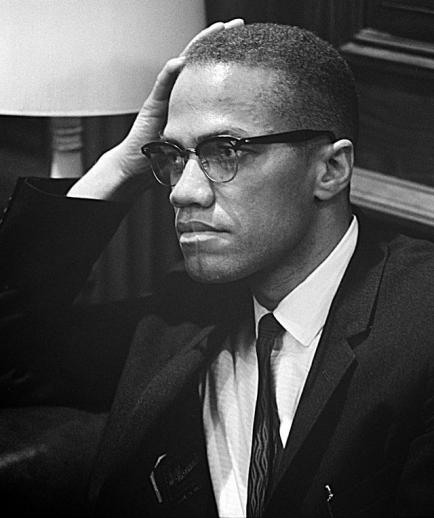
Malcolm X, founder of the Organization of Afro-American Unity (OAAU), was a tremendous radical during the time of Civil Rights, however his recently published diary depicts various goals of his like educating African leaders about the plight of African American in America.
If Martin Luther King Jr.’s dream of domestic social equality turned into a nightmare, Malcolm’s vision for black Americans to join the international community of Africans as an anti-Western bloc was quickly stifled with his 1965 assassination. The OAAU—patterned after the OAU, the Organization of African Unity—represented Malcolm’s domestic and international potential, a painful addition to the pile of 20th-century black historical what-ifs.
“Brother Malcolm was internationalizing the movement,” said event organizer A. Peter Bailey, who was only in his early 20s when he edited the OAAU’s newsletter, The Blacklash. “He was on a conscious effort to connect the struggle against racism in America to the struggle against colonialism internationally, especially in Africa.”
The OAAU event, which took place on June 28—the to-the-day 50th anniversary—at the Malcolm X & Dr. Betty Shabazz Memorial and Educational Center (the former Audubon Ballroom, where Malcolm was assassinated), came in the wake of a newly published diary of Malcolm X. The book, edited by journalist-historian Herb Boyd and writer Ilyasah Al-Shabazz, one of Malcolm X’s six daughters, is called The Diary of Malcolm X: El-Hajj Malik El-Shabazz, 1964. Finally freed from scholarly microfilm, the diary has been the subject of a court case between the authors and the publisher, Third World Press, and Malcolm’s other five daughters, who did not sign off on the book’s publication.
Malcolm’s diary paints the picture of a man eager to find his religious and political centers. Most of the first half of the book details his much-talked-about trip to Mecca in Saudi Arabia, while the second half—which takes place after the OAAU founding in New York—is more about his travels to Africa, where he meets more than 10 heads of state and is treated like a de facto ambassador of black America.
Read full article here
Find more Black history in our online exhibits.
More breaking news here
Comments Are Welcome
Note: We moderate submissions in order to create a space for meaningful dialogue, a space where museum visitors – adults and youth –– can exchange informed, thoughtful, and relevant comments that add value to our exhibits.
Racial slurs, personal attacks, obscenity, profanity, and SHOUTING do not meet the above standard. Such comments are posted in the exhibit Hateful Speech. Commercial promotions, impersonations, and incoherent comments likewise fail to meet our goals, so will not be posted. Submissions longer than 120 words will be shortened.
See our full Comments Policy here.