Moving Monuments and Considering Community
Share
Explore Our Galleries









Breaking News!
Today's news and culture by Black and other reporters in the Black and mainstream media.
Ways to Support ABHM?
By Shantay Robinson, blackartinamerica.com
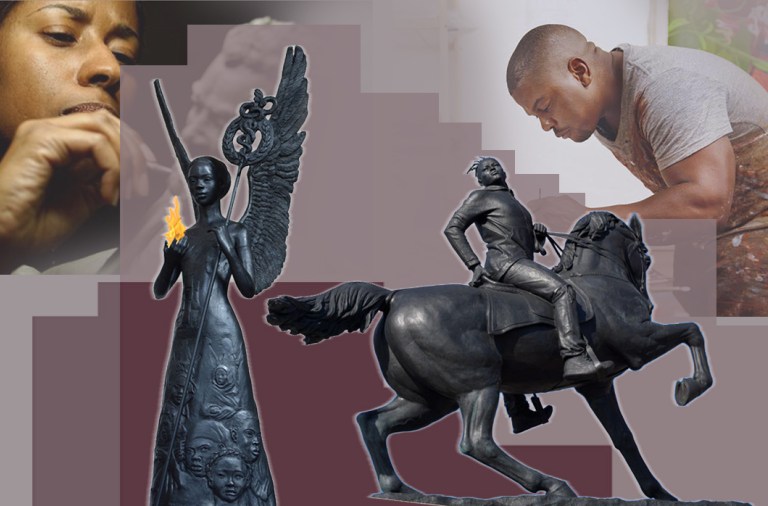
According to Americans for the Arts, “Public art is often site-specific, meaning it is created in response to the place and community in which it resides.” In a document describing why public art matters, Americans for the Arts states, “It reflects and reveals our society, adds meaning to our cities and uniqueness to our communities.” The Association for Public Art states, “Public art can express community values, enhance our environment, transform a landscape, heighten our awareness, or question our assumptions.” If public art is created in response to the community in which the art resides, then the community should definitely have a say in the art that graces their immediate environment. In recent years, there has been some uproar about public art, so much so that people have died and been put in jail in the act of defending their opinions about public art. The personages depicted in the monuments in public spaces, in some cases, have been heinous perpetrators of violence against humanity. These “heroes” have been memorialized, lauded, and celebrated, for centuries. If these monuments are representative of the perspectives of a community, then what are they saying about our communities today?
In 2018, a statue of famed gynecologist J. Marion Sims that was placed in Central Park across the street from the New York Academy of Medicine, was removed because the community voiced protest against its existence. Sims made major advancements in gynecological studies, but it was to the detriment of black women. He experimented on enslaved black women without the use of anesthesia… Despite the major discoveries and advancements in science, these human beings were treated as less than human and tortured for the world’s benefit. They should rightfully have a monument in their names. Sims’ monument will be moved to his gravesite and the true story about his discoveries including his abuse of black women will accompany the monument.
So, while this monument and others are being reconsidered, replaced, and re-contextualized, there are still many monuments throughout the United States that exist in communities where these infamous enshrined individuals have left their heinous marks…
In response to the Confederate monuments, Kehinde Wiley erected a statue titled, Rumors of War, which was unveiled in Times Square in New York City in September 2019. In true Wiley fashion, the personage depicted is of a modernly outfitted black man in a historical posture astride a horse…
Full article here
More Breaking News here
See ABHM galleries here
Comments Are Welcome
Note: We moderate submissions in order to create a space for meaningful dialogue, a space where museum visitors – adults and youth –– can exchange informed, thoughtful, and relevant comments that add value to our exhibits.
Racial slurs, personal attacks, obscenity, profanity, and SHOUTING do not meet the above standard. Such comments are posted in the exhibit Hateful Speech. Commercial promotions, impersonations, and incoherent comments likewise fail to meet our goals, so will not be posted. Submissions longer than 120 words will be shortened.
See our full Comments Policy here.