Milton House: An Underground Railroad “Station” in Wisconsin
Share

Most Recent Exhibit

Breaking News!
Today's news and culture by Black and other reporters in the Black and mainstream media.
Ways to Support ABHM?
Scholar-Griot: Fran Kaplan, MSW, EdD
Imagine you were a slave in 1858 trying to escape your bondage in the South. You would very likely try to connect with the Underground Railroad.
The Underground Railroad was not a real railroad at all. Instead, it was a secret network of safe houses, churches, barns, caves, and private homes where abolitionists1 hid Black men, women and children trying to flee enslavement. “Conductors” guided Freedom Seekers from one safe location to another, often traveling at night and using coded language to protect everyone involved. Most conductors were Black, but many were White.
What it was like to run from enslavement and hide from slave catchers? Visit Milton, a small town in the State of Wisconsin, to get a sense of that terrifying experience.

Wisconsin's only certified Underground Railroad site open for tours. National Historic Landmark in Milton, WI.
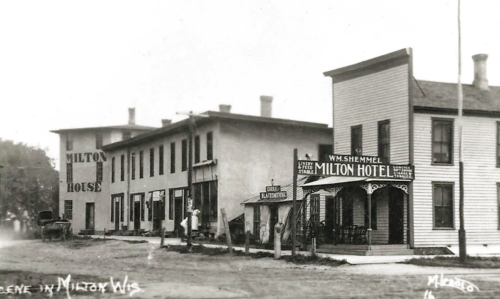
Historic photo of the Milton House. Circa 1900.
The Milton House Museum is not an ordinary historic house. The pale stone building has an unusual six-sided shape, called a “hexagon house.” It was built as a hotel in the 1840s by Joseph Goodrich, a White businessman, a determined abolitionist, and conductor on the Underground Railroad. At first glance, the building seems quiet and peaceful. But beneath it lies a powerful story of courage, secrecy, and resistance to slavery.
When you begin your tour, you walk through rooms filled with household objects from the mid-1800s: furniture, tools, clothing. Guides explain what life was like in Wisconsin when it was still a young state and tensions over slavery were growing across the country. Travelers used to stop at the Milton House Inn for food, rest, and shelter. Hidden among these ordinary activities, however, was a dangerous secret operation.
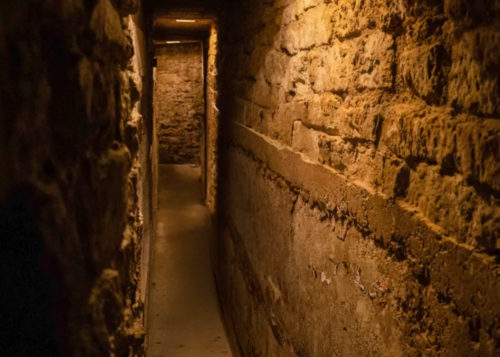
This tunnel beneath the Milton House was used by freedom seekers traveling the Underground Railroad. Originally just 3.5 feet high, it was enlarged in the 1950s to allow visitors to pass through the space.
During the tour, you’ll descend into the dim cellar beneath the building. The air becomes cooler and quieter. Stone walls surround the narrow underground space, and your guide explains how people escaping slavery hid there to rest before continuing north. From the cellar, you’ll enter the small brick-lined tunnel that stretches underground toward a log cabin behind the hotel. The tunnel is low, dark, and cramped. You can easily imagine the fear and uncertainty that Freedom Seekers experienced. Moving through the passage today can feel unsettling even for a few minutes. For people fleeing slavery, the danger was great. If captured, they would be beaten, imprisoned, and forced back into slavery. The abolitionists who hid them could face heavy fines or go to prison.
Andrew Pratt was a Freedom Seeker who escaped slavery and hid at the site while traveling north. Like many who used the Underground Railroad, Pratt depended on the bravery of strangers willing to risk arrest to help him. The Milton House cellar displays a letter from him.
The dangers to fleeing slaves and to abolitionists supporting them increased after Congress passed the Fugitive Slave Act of 1850. This law required citizens and government officials in free states to assist in capturing escaped slaves. These Freedom Seekers could be arrested without a fair trial. The law angered many people in Wisconsin, where strong anti-slavery feelings were growing.2
The State of Wisconsin became nationally important in the fight against the Fugitive Slave Act because of the case of Sherman Booth, a White abolitionist. In 1854, Booth helped rescue an escaped enslaved man named Joshua Glover from a Milwaukee jail after Glover had been captured under the Fugitive Slave Act. Angry citizens stormed the jail with Booth. They freed Glover, helping him continue on the Underground Railroad to Canada. Booth was arrested for violating federal law, but the Wisconsin Supreme Court declared the Fugitive Slave Act unconstitutional. Although the United States Supreme Court later overturned Wisconsin’s decision, the conflict showed how fiercely many Wisconsinites opposed slavery and federal enforcement of that law.
The Underground Railroad stretched across many states, from the South into the North and even into Canada, where slavery had been outlawed. Thousands of enslaved African Americans risked everything for the chance to live freely. People of different races and backgrounds participated in the network. Most “Conductors” were Black, including residents of free Black communities and formerly enslaved people, but many were White Quakers3 and other White abolitionists. Every stop along the route required secrecy, trust, and enormous courage.
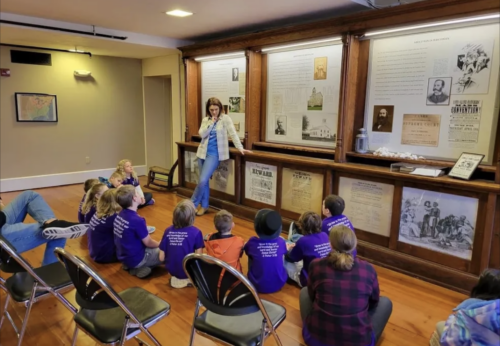
Docent and students in the introductory room of the Milton House Museum.
Today, the Milton House Museum helps visitors understand that the fight against slavery was not limited to the South. Wisconsin also played a role in the national conflict over freedom and human rights. Walking through the dark tunnel and hearing stories like Andrew Pratt’s allows visitors to connect emotionally with a history that can otherwise feel long ago and far away. The experience turns names and dates from textbooks into real human experiences of fear, hope, and determination.
Milton House is a designated National Historic Landmark and part of the National Park Service’s Underground Railroad Network to Freedom program.
Milton House Museum is located at 18 S Janesville St, Milton, WI 53563.
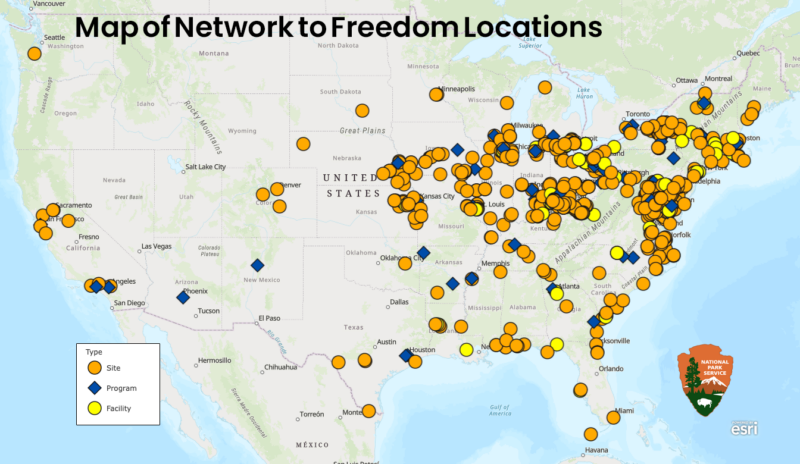
Click the image and explore the National Park Service's Network to Freedom map, an interactive resource identifying more than 800 locations with verified connections to the Underground Railroad, including the Milton House.
Other museums about the Underground Railroad:
- National Underground Railroad Freedom Center: Situated in Cincinnati, Ohio, steps away from the Ohio River, this major "museum of conscience" highlights the stories of the Underground Railroad and connects these historical struggles for freedom to the fight against today’s human trafficking.
- Niagara Falls Underground Railroad Heritage Center: Located in Niagara Falls, New York, this center tells authentic stories of the Freedom Seekers and abolitionists who navigated one of the most critical crossing points on the Underground Railroad before reaching Canada.
- Rokeby Museum: Found in Ferrisburgh, Vermont, this beautifully preserved 18th-century home was a highly documented Underground Railroad stop operated by the Robinson family.
- Harriet Tubman Underground Railroad National Historical Park: Located in Church Creek, Maryland, this immersive visitor center explores the daring life and rescue missions of Harriet Tubman.
Footnotes:
1Abolitionist: A person who worked to abolish (get rid of) slavery.
2The abolitionist movement in the USA used various methods to undo slavery:
- Key Activists: Leaders included escaped formerly enslaved individuals like Frederick Douglass and Harriet Tubman, as well as White journalists and religious advocates such as William Lloyd Garrison and the Grimké Sisters (Sarah and Angelina).
- Tactics: Early abolitionists focused on moral persuasion, print campaigns, political action, and Underground Railroad networks to help Freedom Seekers escape.
- Historical Success: The efforts of abolitionists helped pave the way for the President Abraham Lincoln’s Emancipation Proclamation in 1863 and the ratification of the Thirteenth Amendment to our Constitution in 1865.
3A Quaker is a member of the Religious Society of Friends, a historically Protestant Christian movement founded in 17th-century England. Quakers are pacifists. They worship in meetings – without pastors, priests, or prayerbooks.
Dr. Kaplan, independent scholar, filmmaker, and social activist, is Coordinator of the America's Black Holocaust Virtual Museum. She co-authored an award-winning screenplay, Fruit of the Tree, based on the life of James Cameron. Dr. Kaplan served as Managing Editor and co-wrote the introduction to the expanded 3rd edition of Dr. Cameron's memoir, A Time of Terror: A Survivor's Story.