Meet the woman helping preserve the legacy of Black cowboys and cowgirls
Share
Explore Our Galleries









Breaking News!
Today's news and culture by Black and other reporters in the Black and mainstream media.
Ways to Support ABHM?
By Emma Sánchez, NBC News
The founder of a literacy nonprofit in North Carolina has gained a social media following as “The Black Cowgirl,” showcasing her life and Black equestrian culture.
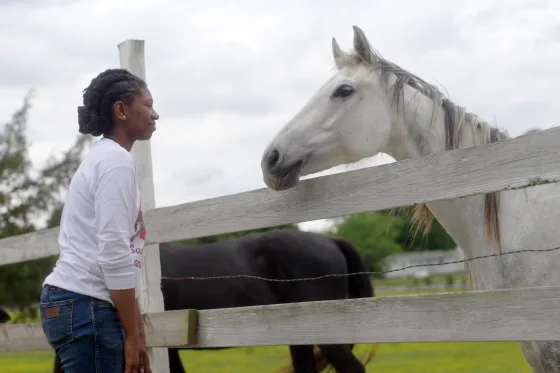
While Black cowboys and cowgirls were essential to the Western frontier, they’ve rarely been depicted in classic Western films. Caitlin Gooch, a 30-year-old North Carolina native, has committed her life to teaching Black children about this overlooked kinship, both through books and fun horse activities.
Caring for horses is something Gooch has always known. She began riding horses at 3, and today she is the keeper of her father’s 30-horse stable and farm. Generations before her, Black pioneers expertly worked with horses to entertain, compete and cultivate the land, giving way to a rich history of Black cowboys and cowgirls in the U.S. that has gone fairly ignored until recently. In 1875, for instance, the first Kentucky Derby was won by a Black jockey, Oliver Lewis; in fact, 15 of the first 20 derbies were won by Black jockeys, according to the Library of Congress.
The 2021 movie “The Harder They Fall,” starring Jonathan Majors, Idris Elba and Regina King, depicts cowboy Nat Love (Majors) and Bill Pickett (Edi Gathegi), the latter a groundbreaking Black rodeo performer in the early 1900s. Pickett is known for originating the “bulldogging” technique of grabbing cattle by the horns and making it fall on its side, a technique that is still used today, according to the National Cowboy Museum. That same year, the movie “Concrete Cowboy” — also starring Elba — came out, depicting a modern-day nonprofit that brings together Black Philadelphians with horses, the Fletcher Street Urban Riding Club.
Gooch said it has been difficult finding information on Black women equestrians, herders and jockeys. Still, some of the trailblazers she has identified include Sylvia Bishop, the first Black woman licensed to officially train thoroughbreds in 1954, and Cheryl White, the first Black woman licensed to jockey in the nation in the early 1970s, according to the International Horse Museum.
Discover more of these pioneers.
Some people are unfamiliar with Black cowboys, just like they’re unaware of the Black politicians and business owners during reconstruction.
Our breaking news section covers Black culture stories.
Comments Are Welcome
Note: We moderate submissions in order to create a space for meaningful dialogue, a space where museum visitors – adults and youth –– can exchange informed, thoughtful, and relevant comments that add value to our exhibits.
Racial slurs, personal attacks, obscenity, profanity, and SHOUTING do not meet the above standard. Such comments are posted in the exhibit Hateful Speech. Commercial promotions, impersonations, and incoherent comments likewise fail to meet our goals, so will not be posted. Submissions longer than 120 words will be shortened.
See our full Comments Policy here.