Longest-running housing discrimination case outlives judge
Share
Explore Our Galleries









Breaking News!
Today's news and culture by Black and other reporters in the Black and mainstream media.
Ways to Support ABHM?
by Ed White, apnews.com
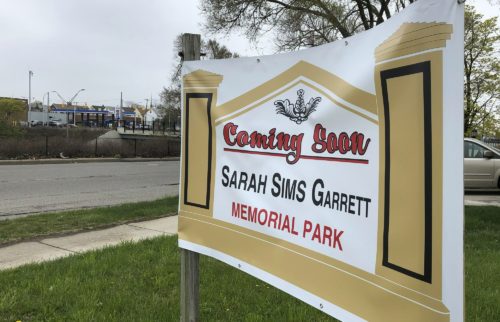
This May 2, 2019, photo shows the site of a future park in Hamtramck, Mich., honoring Sarah Garrett, the lead plaintiff in a 1968 lawsuit that accused the city of racial discrimination by destroying black neighborhoods is seen. Hamtramck agreed to build 200 units of single-family housing as a remedy. Three houses still remain to be built. Federal Judge Damon Keith recently died at age 96 without seeing the end of the case. (AP Photo/Ed White)
HAMTRAMCK, Mich. (AP) — A federal judge who worked until his recent death at age 96 left a historic trail of groundbreaking legal opinions. But one case outlived Damon Keith: the longest-running housing discrimination lawsuit in the United States.
Keith declared in 1971 that Hamtramck, a tiny Detroit-area city long known for Polish culture, had intentionally forced out blacks or cut them off from the community to make room for Interstate 75 and so-called urban renewal projects in the 1950s and ’60s.
Hamtramck finally agreed to offer 200 family housing units, as well as housing for senior citizens, for violating the constitutional rights of black residents. Yet even today — decades later — there still are three houses left to build. Keith, who died on April 28, won’t see the keys change hands, an unfortunate postscript for a judge whose steadfast enforcement of civil rights was the emblem of his career.
“The finish line will probably be this summer,” said Michael Barnhart, an attorney who has represented generations of black families in the litigation. “I know his health was declining, but I wanted him to be there after all these years.”
Hamtramck Mayor Karen Majewski said: “It’s bittersweet. The end really is around the corner.”
Keith, the grandson of slaves, was a judge for 52 years, first at the U.S. District Court in Detroit, followed by 42 years on a federal appeals court. He made history on the bench, ruling against the Nixon administration’s use of warrantless phone taps and ordering George W. Bush’s administration to open deportation hearings.
In the Hamtramck lawsuit, filed in 1968, Keith noted that blacks made up less than 15% of the city’s population but represented more than 70% of residents whose neighborhoods were broken up because of the path of I-75. He also cited other examples.
“The judge referred to it as the ‘black removal case,’” Barnhart said. “It was an extreme example of racial discrimination…”
Read full article here
More Breaking News here
View more ABHM galleries here
Comments Are Welcome
Note: We moderate submissions in order to create a space for meaningful dialogue, a space where museum visitors – adults and youth –– can exchange informed, thoughtful, and relevant comments that add value to our exhibits.
Racial slurs, personal attacks, obscenity, profanity, and SHOUTING do not meet the above standard. Such comments are posted in the exhibit Hateful Speech. Commercial promotions, impersonations, and incoherent comments likewise fail to meet our goals, so will not be posted. Submissions longer than 120 words will be shortened.
See our full Comments Policy here.