Jan Rodrigues: The First Black Man on the Island of Manhattan
Share
Explore Our Galleries









Breaking News!
Today's news and culture by Black and other reporters in the Black and mainstream media.
Ways to Support ABHM?
By Steven J. Niven, theRoot.com
In 1613, seven years before the Pilgrims landed in Plymouth, and six years before a Dutch vessel sold 20 Africans to the Virginia colonists at Jamestown, a black man named Jan Rodrigues was the first non-Native American to settle and trade on what is now Manhattan Island.
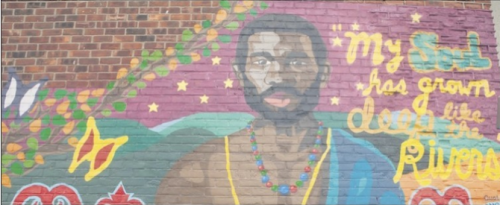
Mural of Jan Rodrigues in Harlem River Park
Rodrigues, described in Dutch records as “Spanish” and a “black rascal,” was born in Santo Domingo (present-day Dominican Republic) to a European (possibly Portuguese) father and a mother of African descent, and where he was presumably known as Juan Rodriguez.
Other than a fairly small number of Spanish bureaucrats and colonists, the majority of people on Santo Domingo were black or mixed race—some enslaved, some free—and many shared a culture that was influenced by the indigenous Taino population.
…Rodrigues, like much of the Santo Domingo population, began to make a living through smuggling, an occupation that became more lucrative after 1600, when Dutch, Portuguese, French and English vessels began arriving in the Caribbean in much greater numbers en route to their own planned colonies in North and South America…
At some point before the summer of 1613, Rodrigues joined the crew of the Dutch merchant shipJonge Tobias, captained by Thijs Mossel, on its voyage from the Caribbean to the East Coast of North America, including a journey up the Hudson River. The vessel anchored off Manhattan Island, where the crew traded furs with the native Lenape. Perhaps, like Mathieu da Costa, Rodrigues was an able linguist who could converse with them in pidgin. Several weeks later, Mossel commanded his crew to return to the Netherlands, but Rodrigues refused to leave, claiming that as a free man, he had a right to choose.
Mossel reluctantly agreed to leave him there and left him with 80 hatchets, some knives, a musket and a sword. Over several months, Rodrigues traded with various native bands and with other Dutch vessels in the region, including one captained by Adrian Block, who was mapping Long Island Sound. When Block returned to the Netherlands later that year, he discovered that Mossel was suing him in court. Mossel claimed that Rodrigues was his servant and that his presence on Manhattan was in service of protecting Mossel’s exclusive trading rights with the islanders. Block disagreed.
Block stated that Rodrigues was a free man, not a servant, and was acting on his own authority, not on Mossel’s behalf. Another Dutch captain, Hendrick Christiaensen, testified in support of Block’s claim that Rodrigues was a free man, based on his several months living with native groups as a translator for Christiaensen’s own negotiations with a band of Rockaway Indians.
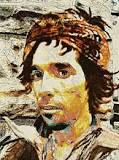
Contemporary Dutch painting purported to be a likeness of Rodrigues
Rodrigues did not testify in the case, but he made clear his views of his former ship captain when the Dutchman, Mossel, returned to Manhattan in April 1614 aboard a new vessel. Upon sighting Mossel, now captain of the Nachtegael, on the Hudson, Rodrigues fired his musket at the ship. The Dutch crew, armed with swords, guns and torches, responded by chasing him onto the island, where he was briefly wounded and captured. Rodrigues somehow managed to grab a sword from one of his pursuers and escaped to the safety of Christiaensen’s vessel. For Mossel, Rodrigues’ resistance proved his claim that he was a renegade “black rascal” and not free. The Dutch courts disagreed with him, however, and by not returning Rodrigues to Mossel, implicitly ruled that he was a free man.
With the conclusion of the court case, Rodrigues disappeared from the written historical record. Some accounts suggest that he remained in Manhattan and established a trading post, where he was supplied with axes, kettles and other metal tools to barter with the Lenape. As the first-known nonindigenous resident of the region, he had knowledge about local language, customs and values that was invaluable to the growing number of Dutch visitors and settlers. He may have married and had children with a local woman and was perhaps still in the region when the Dutch West India Company arrived in Manhattan in 1625…
Race-based slavery would gradually entrench itself in New Amsterdam, which would later become New York, as well as in all of the mainland Colonies, and the history of Manhattan’s first free black resident was largely forgotten until the late 1950s, when Dutch historians discovered his case in the Colonial archives. But it was not until 2013 that the English and Spanish translation of his court case became widely available through the Dominican Studies Institute at the City College of New York.
Read the full article here.
Read more Breaking News here.
Comments Are Welcome
Note: We moderate submissions in order to create a space for meaningful dialogue, a space where museum visitors – adults and youth –– can exchange informed, thoughtful, and relevant comments that add value to our exhibits.
Racial slurs, personal attacks, obscenity, profanity, and SHOUTING do not meet the above standard. Such comments are posted in the exhibit Hateful Speech. Commercial promotions, impersonations, and incoherent comments likewise fail to meet our goals, so will not be posted. Submissions longer than 120 words will be shortened.
See our full Comments Policy here.