Internalizing White Supremacy: What We Can Learn From Liberia
Share
Explore Our Galleries









Breaking News!
Today's news and culture by Black and other reporters in the Black and mainstream media.
Ways to Support ABHM?
We have no control over how white America treats us, but we do have control over how we treat each other.
By Christopher Richardson, former U.S. diplomat, NewsOne
In the wake of the shootings of George Floyd, Breonna Taylor and Jacob Blake, many white Americans are grappling with the realization that racism is deeply entrenched in society. Yet, for Black Americans, an uncomfortable question is whether white racism is so foundational to the American experience that inevitably it lives even within us. Regrettably, that question was first answered centuries ago when a band of former slaves and freed Blacks left the United States to start their own country. …
Yet, though their intentions were good, they could not escape the trauma of their oppressed experience. Thus, in a land of thatch huts, the Americo-Liberians built grand plantation style mansions with stately colonnades, spacious rooms and verandas equal to the ones they left back in the United States. Despite the equatorial climate, they dressed in formal nineteenth century clothes including top hats and frock coats. They adopted the symbols of home such as a red, white and blue flag. They named their settlements and towns along the coast Georgia, Virginia, Kentucky, Maryland, Louisiana and Mississippi.
…The Americo-Liberians wrote their own Declaration of Independence which began “We, the people of the Republic of Liberia were originally the inhabitants of the United States of North America.” The problem, though, is that “we, the people” did not include the original inhabitants of Liberia itself. Three major ethnic groups – the Kwa, Mande, and Mel – lived there long before the Americo-Liberians arrived. Despite only consisting of no more than 4 percent of the overall population, the Americo Liberians deprived the indigenous groups of citizenship in the new country. …
…Thus, as Black Americans, we are indeed vulnerable to replicating the system we are bathed in. …
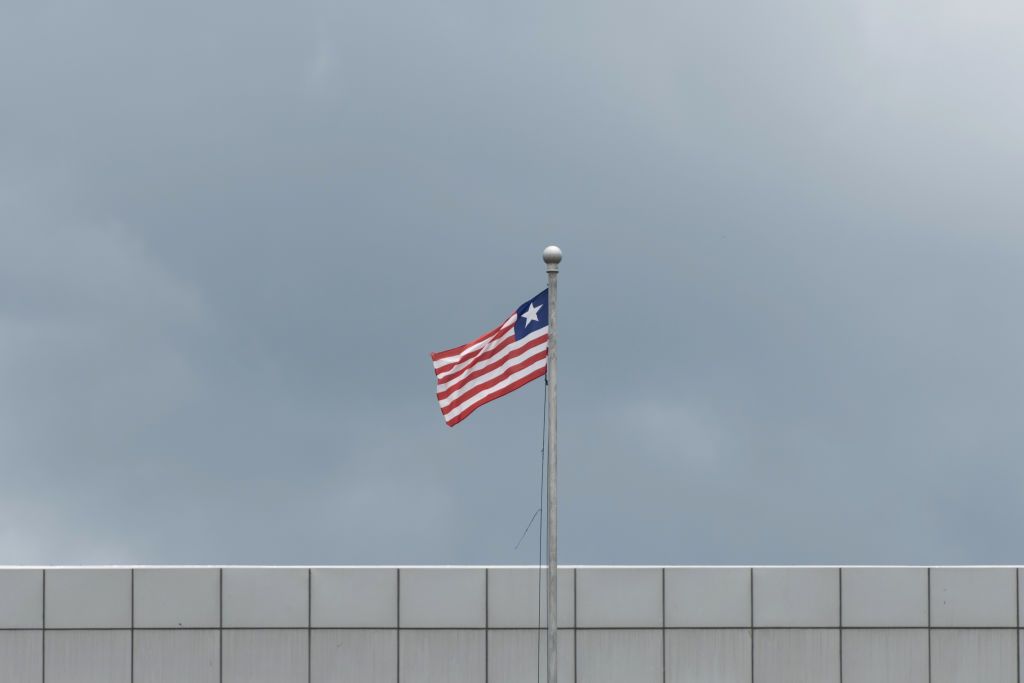
The flag in Liberia in a cloudy background.
…Even an ocean away from white supremacy and surrounded by Blackness, these former slaves sought the approval and lives of their former masters. Yet how could they not for oppression was all they knew. In America, we have all been socialized the same: We read the same stories and have been told the same lies. Thus, as Black Americans, we are indeed vulnerable to replicating the system we are bathed in.
Read the full article here
Learn more about the struggles of newly freed African Americans to make lives for themselves after the Civil War here.
And about how African immigrants to the US are now being deported in large numbers here.
More Breaking News here.
Comments Are Welcome
Note: We moderate submissions in order to create a space for meaningful dialogue, a space where museum visitors – adults and youth –– can exchange informed, thoughtful, and relevant comments that add value to our exhibits.
Racial slurs, personal attacks, obscenity, profanity, and SHOUTING do not meet the above standard. Such comments are posted in the exhibit Hateful Speech. Commercial promotions, impersonations, and incoherent comments likewise fail to meet our goals, so will not be posted. Submissions longer than 120 words will be shortened.
See our full Comments Policy here.