In Tuscany, a Dinner to Celebrate Black Queer Artists
Share
Explore Our Galleries









Breaking News!
Today's news and culture by Black and other reporters in the Black and mainstream media.
Ways to Support ABHM?
By Laura May Todd, New York Times
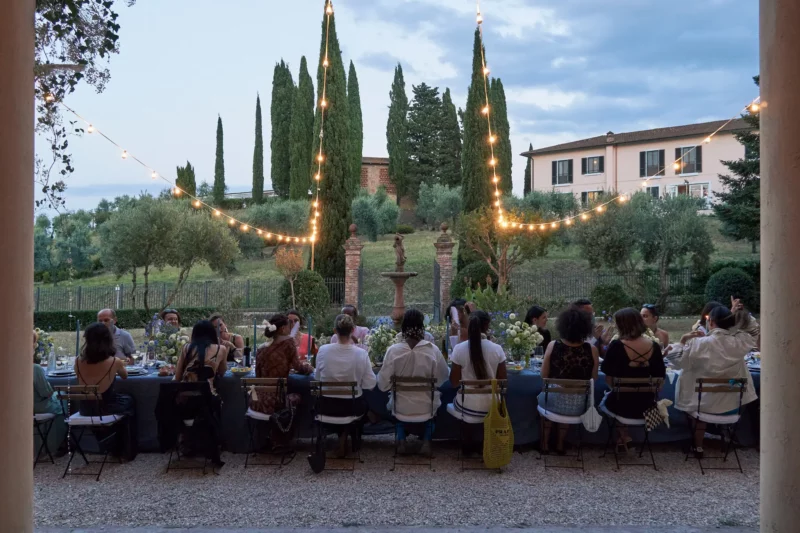
On a July night in rural Italy, despite a stifling heat wave, a row of dinner guests danced in their seats at a long wooden table. Beyoncé’s latest album, “Renaissance,” pumped out of hidden speakers and, as the sun sank behind the olive groves in the distance, servers brought out bottles of Sangiovese wine and baskets of focaccia. It was the final week of the summer artist residency program at Villa Lena, a boutique hotel and farm stay in Tuscany, and the guests were celebrating a peaceful, productive month in the countryside.
The meal also marked the conclusion of the third year of the MQBMBQ (short for My Queer Blackness, My Black Queerness) residency, organized by the creative director and writer Jordan Anderson, 25. Each year, three Black queer artists are chosen by Anderson and Villa Lena’s staff to join a cohort of six or so summer residents, all expenses paid. “I wanted to make sure that Black queer people from all over the world aren’t being left out of these experiences,” he says, “whether the restrictions are finances or location.”
Born in Jamaica and based in Milan, Anderson moved to Italy in 2017 and soon saw the country as a refuge. “Homophobia can make living in Jamaica complicated,” he explains. He supported himself by working as an au pair and English teacher while he built up his portfolio as a fashion writer, curator and creative director. In 2020 he launched the first iteration of MQBMBQ, an online platform that features Black queer artists in interviews, profiles and photo series. With the site, Anderson could celebrate the figures that he wished he saw more of in the mainstream press.
[…]
The 2023 recipients were the composer Jordan Boucicaut, 30, the performance artist Z Tye, 31, and the writer Camille Gallogly Bacon, 25, all of whom spent the month working in their own dedicated studios and living together in the property’s 19th-century villa. For the first time, the residents were joined by a mentor: Kimberly Drew, 33, a critic, author and curator at Pace Gallery in New York. “Projects like these are vital to [people from] all backgrounds, but it’s [even] more urgent for marginalized groups,” Drew says. The program gives each artist “not only time to build their practice but new people to do it alongside.”
Both racism and homophobia can impact Black artists.
Comments Are Welcome
Note: We moderate submissions in order to create a space for meaningful dialogue, a space where museum visitors – adults and youth –– can exchange informed, thoughtful, and relevant comments that add value to our exhibits.
Racial slurs, personal attacks, obscenity, profanity, and SHOUTING do not meet the above standard. Such comments are posted in the exhibit Hateful Speech. Commercial promotions, impersonations, and incoherent comments likewise fail to meet our goals, so will not be posted. Submissions longer than 120 words will be shortened.
See our full Comments Policy here.