In Derrick Adams’ paintings, Black history collides joyfully with the present
Share
Explore Our Galleries



Breaking News!
Today's news and culture by Black and other reporters in the Black and mainstream media.
Ways to Support ABHM?
By Leah Dolan, CNN
As a young Black artist studying at Columbia University in New York, Derrick Adams made a discovery that would impact his career forever. “The unfortunate side of being a Black person is that everything you make is political,” he told CNN at the opening of his latest exhibition. “You make flowers, it’s political. You make rainbows, you make butterflies, it’s political. When I came to that realization in (school) it actually freed me up, because I didn’t have to think about being political… I’m walking politics.”
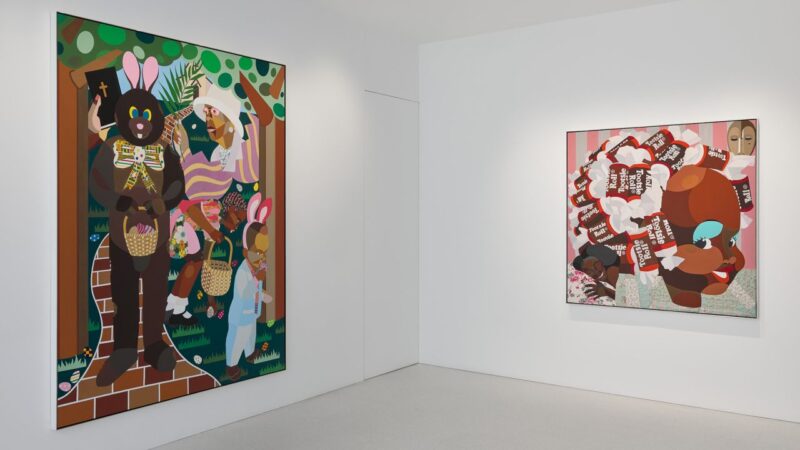
In “Situation Comedy,” on show at the Gagosian gallery in London, running until March 22, it’s all too easy to fall into the trap of politicizing Adams’ work. Is the floating girl sporting the afro made from Tootsie Rolls in “Only Happy Thoughts” (2024) a visual innuendo referencing a racial slur? Could the Black cowboy pictured in “Getting the Bag” (2024) be a comment on an oft-forgotten part of African-American history? (While popular culture would have you believe ranching and horse riding were exclusively the domain of White men, historians estimate that one in four cowboys during the 1900s were Black). They could be. But they could also be exactly what you see — vibrant, larger-than-life figures in playful compositions with prismatic skin tones. Crucially, Adams says, it is up to you.
“I like the idea of letting things flow through me in a way that’s more intuitive and allowing people to rummage through it and pick out things that resonate with them,” he said.
‘It allows people to have an escape’
For Adams, who was born in Baltimore in 1970, painting is a way of “bookmarking” his own personal interests and fixations: Telfar bags, 19th-century ceramics, Kenyan Masai warrior sculptures bought on 125th street in Harlem, the sky-high hairstyles of Halle Berry and Natalie Desselle in the 1997 movie “B.A.P.S”. Some of these references are more academic than others. “(My work) has all the symbolism and all of the entry points that could make it way more complex,” he said. “But it also allows people to have an escape if they don’t want to do that.”
In his latest show, there is a focus on respite and recreation — powerful states of being that are often only afforded to those in higher socioeconomic brackets. In 2020, the Center for American Progress found that people of color were three times more likely than White people to live in areas where nature is not immediately accessible, and were therefore deprived of the health and well-being benefits that come with the ability to relax outdoors. But in Adams’ dreamlike compositions, Black figures are either in repose sleeping, having a picnic on the beach or in a forest hunting for Easter eggs.
Adams’ depiction of Black people in scenes of leisure, almost exclusively in bright colors, means his work is regularly branded as an example of “Black joy” — an increasingly popular description of Black figurative painting that doesn’t reference trauma. But Adams finds the label to be “flattened” and indicative of the pigeonholing of Black artists. “There was no real category for the work I was making,” Adams said of his early career. “People looked at it as this idea of Black joy, because I think that’s the only category they could think of… I had to fall into it, because that was an entry point to people talking about it.”
Head to the original article to get details on the artist and exhibit.
See other artists in our Special Exhibits.
More breaking Black news.
Comments Are Welcome
Note: We moderate submissions in order to create a space for meaningful dialogue, a space where museum visitors – adults and youth –– can exchange informed, thoughtful, and relevant comments that add value to our exhibits.
Racial slurs, personal attacks, obscenity, profanity, and SHOUTING do not meet the above standard. Such comments are posted in the exhibit Hateful Speech. Commercial promotions, impersonations, and incoherent comments likewise fail to meet our goals, so will not be posted. Submissions longer than 120 words will be shortened.
See our full Comments Policy here.