‘I felt this film was my duty’: director Mati Diop on Dahomey, about the return of looted African treasures
Share
Explore Our Galleries









Breaking News!
Today's news and culture by Black and other reporters in the Black and mainstream media.
Ways to Support ABHM?
By Jonathan Romney, The Guardian
The French-Senegalese film-maker on winning the top prize at Berlin for her otherworldly new work, cultural identity and her beef with Beyonce.
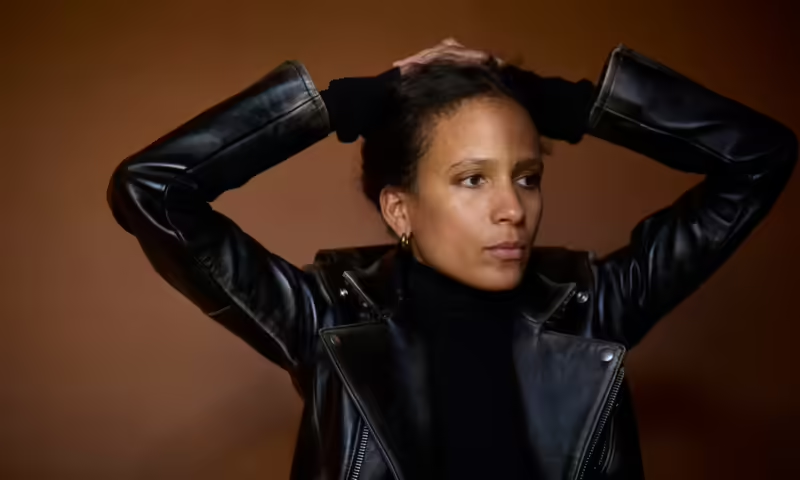
[…]
Part documentary, part visual and sonic poem, Dahomey follows a consignment of historical artefacts as they are returned by the French government to their source in the former African nation of Dahomey, now Benin. This year’s winner of the Berlin film festival’s top prize, the Golden Bear, Dahomey is the latest triumph for Diop, 42, who for a decade and a half has been a much-admired presence in world cinema, first as an actor, then as a director. She made a memorable acting debut in 2008 in Claire Denis’s hypnotic urban reverie 35 Shots of Rum and later became the first Black female director to have a feature in competition in Cannes. That was 2019’s visionary Atlantics, a story of young Senegalese men who attempt the perilous journey to Europe by boat – only to return as ghosts.
Dahomey tells of another return. Here, the journey back to Africa is that of a set of royal treasures – controversially, a mere 26 items among several thousand looted by troops after France’s 1892 invasion of Dahomey. Sitting in the library of a central London hotel, in town to present her film at the BFI London film festival, Diop explains in French that while the restitution of these artefacts began in 2021, she had already been contemplating a fiction feature on the theme for some years.
“It was going to be about an African mask telling its own story, from being captured to the day it comes home – and in between, the experience of exile in Europe. I was about to start writing – then I read that the royal treasures would be returned.”
[…]
Learning that the statues and other artefacts would return to Benin, Diop realized that she needed to get to work fast and film their transportation: “I felt it was my duty.” She was helped by the Senegalese writer and academic Felwine Sarr, co-author of a study on restitution commissioned by the French president, Emmanuel Macron. Sarr helped oil the wheels with the Benin government, Diop says: “They understood that I needed to be with the works all the time in order to tell the story from the statues’ point of view – and they understood that this wasn’t the government’s film. It had to be my film – and they respected that.”
Continue reading the interview with film director Mati Diop.
Read more news on the repatriation of stolen artifacts.
Follow more Breaking News here.
Comments Are Welcome
Note: We moderate submissions in order to create a space for meaningful dialogue, a space where museum visitors – adults and youth –– can exchange informed, thoughtful, and relevant comments that add value to our exhibits.
Racial slurs, personal attacks, obscenity, profanity, and SHOUTING do not meet the above standard. Such comments are posted in the exhibit Hateful Speech. Commercial promotions, impersonations, and incoherent comments likewise fail to meet our goals, so will not be posted. Submissions longer than 120 words will be shortened.
See our full Comments Policy here.