How Celebrity Hairstylist Chuckie Amos Turned Brandy’s Box Braids into a Site of Refusal
Share
Explore Our Galleries









Breaking News!
Today's news and culture by Black and other reporters in the Black and mainstream media.
Ways to Support ABHM?
Dori Walker and Alessandra Maldonado, Complex
Celebrity hairstylist Chuckie Amos has shaped some of pop culture’s most enduring images, from Brandy’s “The Boy Is Mine” era to Beyoncé’s “Dangerously in Love.” In conversation, he reflects on how braids became a site of innovation, protection, and possibility within Black hair culture.
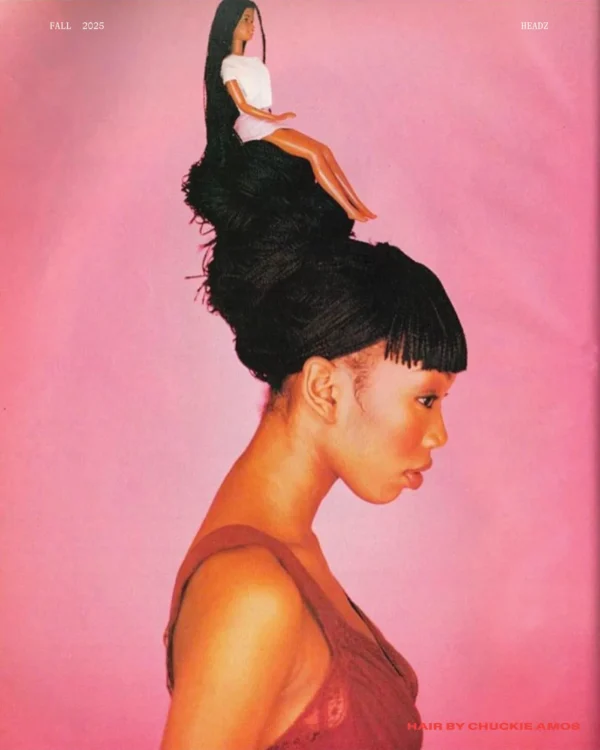
In 1994, Chuckie Amos was a student at NYC’s Fashion Institute of Technology, styling classmates’ hair for $10 a pop. One day, Amos’ friend tapped him to help on a magazine shoot. “I met a girl with braids,” Amos recalls—he styled her hair into Princess Leia buns for the cover. Unbeknownst to him, the girl with braids was Brandy Norwood. A year later, someone from Brandy’s team spotted Amos eating lunch at Rockefeller Center and remembered him from the shoot. Next thing he knew, he was streaking Brandy’s hair with threads of gold for the ’96 American Music Awards.
But as Amos put it, Brandy came with rules, and those rules came from “Mama No” (a nickname for Brandy’s mom, for Sonja Norwood). She erred on the side of caution, enforcing boundaries on her daughter’s look that sometimes made her look younger—a posture that anticipates and attempts to circumvent the ways young Black girls become the subjects of hypersexualization and adultification in their coming of age, which are risks only amplified by child stardom. Nevertheless, Brandy was equally entitled to experiment with her aesthetic and expression, and the most iconic site of that experimentation became her hair.
Amos says: “The record label said, ‘Forget that it’s braids—make it look like hairstyles that you would do with hair.’” For the rest of the decade, Amos would use the singer’s signature braids as a canvas for innovation—peep the ’60s-style volume in the “Sittin’ Up in My Room” video and the sparkly Rick James-inspired look in “Top of the World.” Though she preferred curtain braids or bangs to frame her face, she gave him free rein. Over time, as the artist continued to come into her own, the artist began implementing more of her own ideas. For her ’98 MTV VMAs performance of “The Boy Is Mine,” she asked Amos to twist her hair up into spikes—a look that launched an early-aughts trend into the stratosphere.
Amos went on to style Alicia Keys, Beyoncé, and other luminaries. But it all started with the girl with braids, who helped popularize a Black hairstyle for mass audiences. “We worked hard for her because we liked her a lot,” he says. “And we knew that we were all going places with Brandy, because she was it.”
Comments Are Welcome
Note: We moderate submissions in order to create a space for meaningful dialogue, a space where museum visitors – adults and youth –– can exchange informed, thoughtful, and relevant comments that add value to our exhibits.
Racial slurs, personal attacks, obscenity, profanity, and SHOUTING do not meet the above standard. Such comments are posted in the exhibit Hateful Speech. Commercial promotions, impersonations, and incoherent comments likewise fail to meet our goals, so will not be posted. Submissions longer than 120 words will be shortened.
See our full Comments Policy here.