How Can You Measure Income Inequality? Count The Trees

Share

Explore Our Galleries

An NAACP flyer campaigning for the Dyer Anti-Lynching Bill, which passed the U.S. House of Representatives in 1922, but was filibustered to defeat in the Senate. Dyer, the NAACP, and freedom fighters around the country, like Flossie Baily, struggled for years to get the Dyer and other anti-lynching bills passed, to no avail. Today there is still no U.S. law specifically against lynching. In 2005, eighty of the 100 U.S. Senators voted for a resolution to apologize to victims' families and the country for their failure to outlaw lynching. Courtesy of the National Association for the Advancement of Colored People (NAACP).
Some Exhibits to Come – One Hundred Years of Jim Crow
Mammy Statue JC Museum Ferris
Bibliography – One Hundred Years Of Jim Crow
Claude, age 23, just months before his 1930 murder. Courtesy of Faith Deeter.
Freedom’s Heroes During Jim Crow: Flossie Bailey and the Deeters
Souvenir Portrait of the Lynching of Abram Smith and Thomas Shipp, August 7, 1930, by studio photographer Lawrence Beitler. Courtesy of the Indiana Hisorical Society.
An Iconic Lynching in the North
Lynching Quilt
Claxton Dekle – Prosperous Farmer, Husband & Father of Two
Ancient manuscripts about mathematics and astronomy from Timbuktu, Mali
Some Exhibits to Come – African Peoples Before Captivity
Shackles for Adults & Children from the Henrietta Marie
Some Exhibits to Come – The Middle Passage
Slaveship Stowage Plan
What I Saw Aboard a Slave Ship in 1829
Arno Michaels
Life After Hate: A Former White Power Leader Redeems Himself

Breaking News!

Today's news and culture by Black and other reporters in the Black and mainstream media.

Ways to Support ABHM?

By Hattie Lee, Colorlines.com

Turns out there’s a direct correlation between the number of trees a neighborhood has and its monetary wealth —
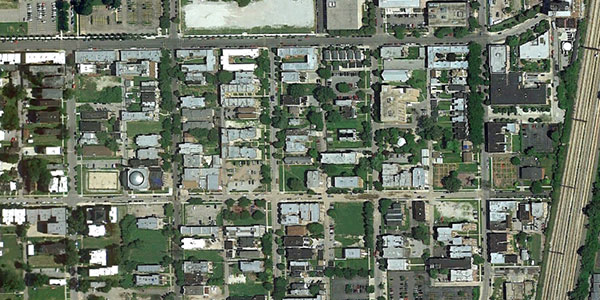
Chicago's Woodlawn neighborhood
Chicago’s Woodlawn neighborhood – 2009 estimated median household income: $22,166

and we can see how this dynamic plays out from space. Environmental journalist Tim De Chant mapped it all out for us on his blog, Per Square Mile, where he worked up a small project called “Income Inequality, As Seen From Space.”

De Chant took satellite images from Google Earth that compared two neighborhoods from selected cities to show income disparities.

Hyde Park is home to the University of Chicago. It has the highest number of Nobel Prize winners per square kilometer of any neighborhood on earth.
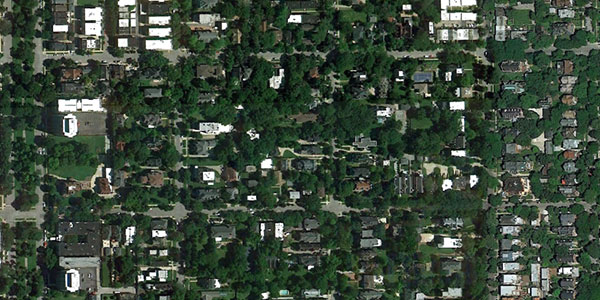
Chicago's Hyde Park neighborhood – 2009 estimated median household income: $48,568
Chicago’s Hyde Park neighborhood – 2009 estimated median household income: $48,568

In the 1950s it experienced “white flight” as a reaction to school desegregation. Today, largely as a result of the University of Chicago’s “urban renewal” (or “removal”) program, it is one of the most economically and social integrated neighborhoods in the US.

Woodlawn neighborhood, just to the south of Hyde Park, is known for its urban blight: high crime, vacant lots, and lack of businesses.

Read more here and here.

More breaking news.

Comments Are Welcome

Note: We moderate submissions in order to create a space for meaningful dialogue, a space where museum visitors – adults and youth –– can exchange informed, thoughtful, and relevant comments that add value to our exhibits.

Racial slurs, personal attacks, obscenity, profanity, and SHOUTING do not meet the above standard. Such comments are posted in the exhibit Hateful Speech. Commercial promotions, impersonations, and incoherent comments likewise fail to meet our goals, so will not be posted. Submissions longer than 120 words will be shortened.

See our full Comments Policy here.

Leave a Comment







