How a Determined Scholar Captured the Breadth of Blackface
Share
Explore Our Galleries









Breaking News!
Today's news and culture by Black and other reporters in the Black and mainstream media.
Ways to Support ABHM?
By Jennifer Schuessler, New York Times
Scouring estate sales, eBay and family basements, Rhae Lynn Barnes amassed a disturbing collection to write “Darkology,” her groundbreaking new book.
In 2013, Rhae Lynn Barnes was a 25-year-old history graduate student on a visit to the grand headquarters of the Elks Club in Chicago. She had put on her most professional suit and had her hair done.
“I wanted to look as serious as possible,” she recalled.
She knew the group, founded in New York City in 1868 as the Jolly Corks, had roots intertwined with blackface minstrelsy, which ruled the stages of northern cities in the decades before and after the Civil War. And in the club’s museum, there was plenty of memorabilia of minstrel shows, including blackface photographs.
But when Barnes asked if she could access the club’s private library and its historical membership rosters, she was denied.
“They were immediately like, ‘Who are you? What are you doing here?’” she said. “And then they called security and escorted me out.”
She started looking for information in other ways, including zooming in on the lapel pins in photographs of early Elks, which indicated lodge, rank and initiation year. Ultimately, she drew up a list of roughly 400 early members.
“I realized there was pretty much nobody who is a famous 19th-century minstrel performer who was not an Elk,” she said. “It just became synonymous.”
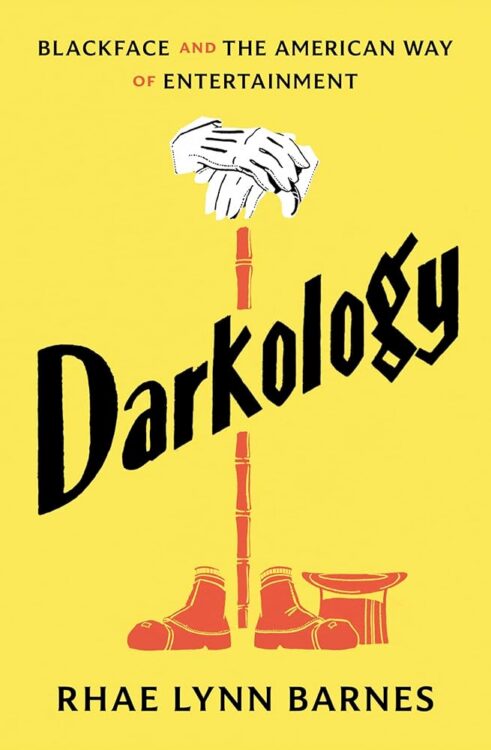
The visit to Chicago was neither the beginning nor the end of Barnes’s digging. In her new book, “Darkology: Blackface and the American Way of Entertainment,” she lays out the fruits of nearly two decades of scouring archives, eBay and estate sales, tracing a long, lurid tradition of amateur blackface performance that stretched deep into the 20th century, and seemingly into every corner of the country.
She chronicles minstrel performances at fund-raisers for politicians, police forces and medical charities (including one cowritten by Franklin Delano Roosevelt). Government-sponsored minstrel shows at World War II-era military bases, and even in Japanese American internment camps. Annual blackface shows at elementary schools and community centers from small-town Maine to suburban California.
Keep reading about Barnes’ book and how she detailed such performances.
Read about one cultural artifact that has surprising origins in minstrelsy.
Comments Are Welcome
Note: We moderate submissions in order to create a space for meaningful dialogue, a space where museum visitors – adults and youth –– can exchange informed, thoughtful, and relevant comments that add value to our exhibits.
Racial slurs, personal attacks, obscenity, profanity, and SHOUTING do not meet the above standard. Such comments are posted in the exhibit Hateful Speech. Commercial promotions, impersonations, and incoherent comments likewise fail to meet our goals, so will not be posted. Submissions longer than 120 words will be shortened.
See our full Comments Policy here.