George Marshall Clark: Unmarked Grave of Milwaukee Lynching Victim Gets Headstone After 160 Years
Share
Explore Our Galleries









Breaking News!
Today's news and culture by Black and other reporters in the Black and mainstream media.
Ways to Support ABHM?
By Editor, milwaukeeindependent.com
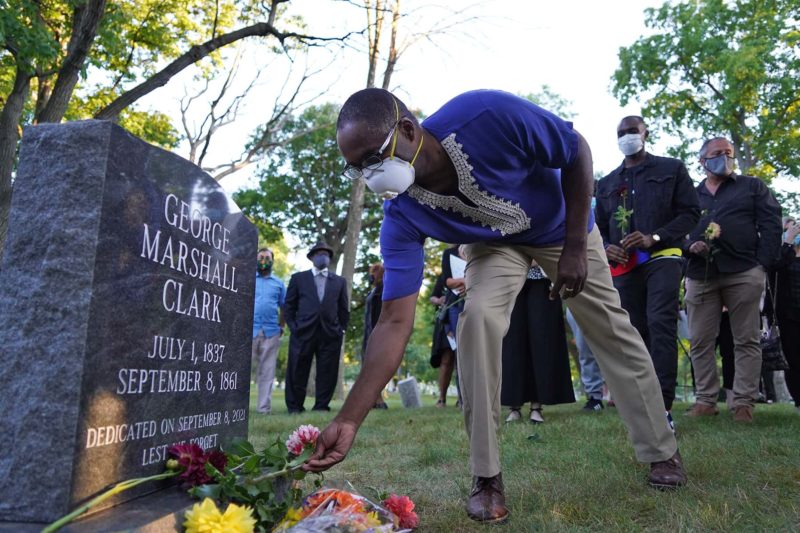
Nearly two centuries after his brief life and brutal death were entered into public record as the only recorded lynching in Milwaukee history, George Marshall Clark’s unmarked grave was memorialized with a granite headstone during a special ceremony at Forest Home Cemetery on September 8.
The event marked the the 160th anniversary of his murder in 1861. City and cemetery records placed Clark’s remains at Forest Home. Local artist and activist Tyrone MackLee Randle Jr. identified the exact location of Clark’s unmarked grave in consultation with Forest Home staff, bringing Clark’s story to wider attention following racial-justice protests in the summer of 2020. A joint fundraising effort by Forest Home Cemetery and Randle secured funds for Clark’s headstone last spring….
“America’s Black Holocaust Museum is uniquely positioned to help acknowledge the life of George Marshall Clark and the tragic events of his death as a charge of our mission. Our founder, Dr. James Cameron, dedicated his life to educating about racial violence and the terror of lynching, which he himself survived,” said Dr. Robert Davis, President and CEO of Black Holocaust Museum (ABHM). “The events of September 7 and 8, 1861 were unfortunately all too common across this nation, where lawless mobs deputized themselves and inflicted egregious harm on Black individuals and communities. ABHM is thankful to join with Forest Home Cemetery and the community in finally memorializing the life and lynching of George Marshall Clark and reconciling with what that means 160 years later….”
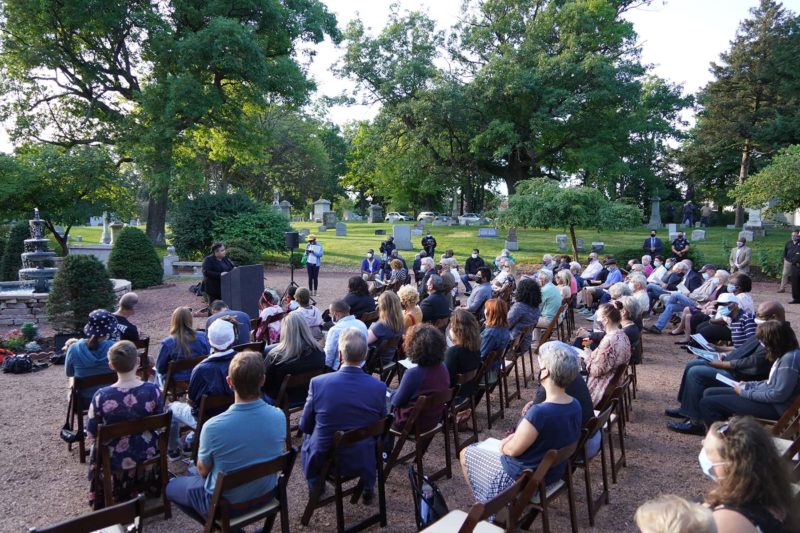
“George Marshall Clark died an innocent young man when his safety and dignity as a Black man were utterly denied him,” said Sara Tomilin, Forest Home Cemetery Assistant Executive Director.
“As Milwaukeeans, we owe it to all young people in our community, and to the memory of Mr. Clark, to properly acknowledge this lynching….”
Alderwoman JoCasta Zamarripa, Milwaukee Independent’s Senior Columnist Reggie Jackson, Marquette University’s Dr. Robert Smith, Pardeep Singh Kaleka, Executive Director for the Interfaith Conference of Greater Milwaukee, and Milwaukee County Executive David Crowley spoke at the dedication ceremony.
Read the full article here.
Learn more about Marshall Clark and the story of how his lynching came about and its place in Milwaukee’s history here.
Visit our Memorial to the Victims of Lynching here.
More Breaking News here.
Comments Are Welcome
Note: We moderate submissions in order to create a space for meaningful dialogue, a space where museum visitors – adults and youth –– can exchange informed, thoughtful, and relevant comments that add value to our exhibits.
Racial slurs, personal attacks, obscenity, profanity, and SHOUTING do not meet the above standard. Such comments are posted in the exhibit Hateful Speech. Commercial promotions, impersonations, and incoherent comments likewise fail to meet our goals, so will not be posted. Submissions longer than 120 words will be shortened.
See our full Comments Policy here.