Forget Dr. Seuss And Cancel Culture – The Real GOP Agenda Is Rolling Back Voting
Share
Explore Our Galleries









Breaking News!
Today's news and culture by Black and other reporters in the Black and mainstream media.
Ways to Support ABHM?
By S.V. Date, HuffPost
From coast to coast, the party is engaged in the “second great disenfranchisement in American history,” says one voting law expert.
WASHINGTON — Just weeks into an era of a new Democratic White House and Congress pushing through their priorities, Republicans appear to have settled on an agenda of their own.
No, not Dr. Seuss or “cancel culture” or breaking up Big Tech or any of the culture war topics that dominate their fundraising appeals and the Fox News evening programming, but the singular issue on which they seem to believe their future success will depend: making it harder for poorer people and communities to vote.
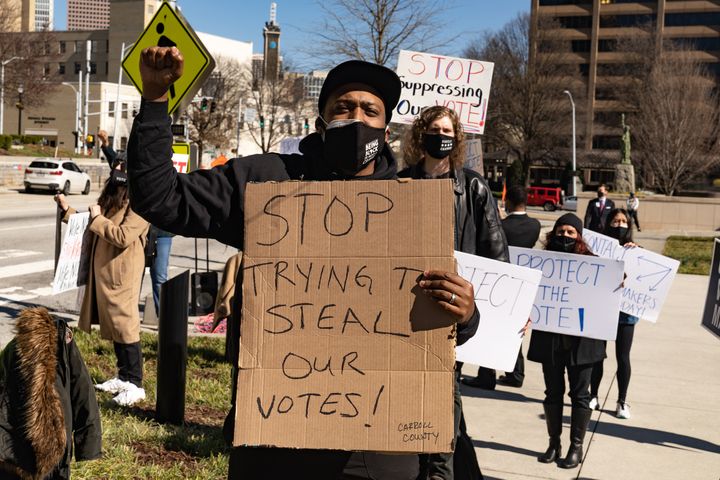
From Juneau, Alaska, to Tallahassee, Florida, and dozens of statehouses in between, Republicans are pushing legislation to cut early voting, eliminate ballot collection boxes, end “no-excuse” absentee voting and undo laws designed to make voting easier, particularly for voters who historically have not engaged in elections. According to the nonpartisan Brennan Center for Justice at New York University, there are already 253 such bills in 43 states and counting.
“We’re in the second great disenfranchisement in American history,” said David Schultz, a professor of election law at Hamline University in St. Paul, Minnesota, ranking our current times just below the Jim Crow years that followed the failure of Reconstruction…
In March 2020, Trump told Fox News that he opposed the House’s version of a COVID-19 relief bill because of the money it contained to help elections officials set up mail voting. “The things they had in there were crazy,” he said. “They had things, levels of voting that, if you ever agreed to it, you’d never have a Republican elected in this country again.”
Days later, the Republican speaker of Georgia’s House was even more explicit. “The president said it best: This will be extremely devastating to Republicans and conservatives in Georgia,” David Ralston told the news site FetchYourNews. “Every registered voter is going to get one of these. Now I ask you … what was turnout in the primary back in 2018 or 2016. Was it 100%? No. No. It’s way, way, way lower. This will certainly drive up turnout.”
And just Wednesday, the Arizona state lawmaker who chairs a key elections committee explained that some people really should not be voting to start with.
“We don’t mind putting security measures in that won’t let everybody vote ― but everybody shouldn’t be voting,” John Kavanagh said. “Not everybody wants to vote, and if somebody is uninterested in voting, that probably means that they’re totally uninformed on the issues. … Quantity is important, but we have to look at the quality of votes, as well.”…
Read the full article here.
Learn about voting rights.
More Breaking News here.
Comments Are Welcome
Note: We moderate submissions in order to create a space for meaningful dialogue, a space where museum visitors – adults and youth –– can exchange informed, thoughtful, and relevant comments that add value to our exhibits.
Racial slurs, personal attacks, obscenity, profanity, and SHOUTING do not meet the above standard. Such comments are posted in the exhibit Hateful Speech. Commercial promotions, impersonations, and incoherent comments likewise fail to meet our goals, so will not be posted. Submissions longer than 120 words will be shortened.
See our full Comments Policy here.