For Black drivers, a police officer’s first 45 words are a portent of what’s to come
Share
Explore Our Galleries









Breaking News!
Today's news and culture by Black and other reporters in the Black and mainstream media.
Ways to Support ABHM?
Nell Greenfieldboyce, NPR
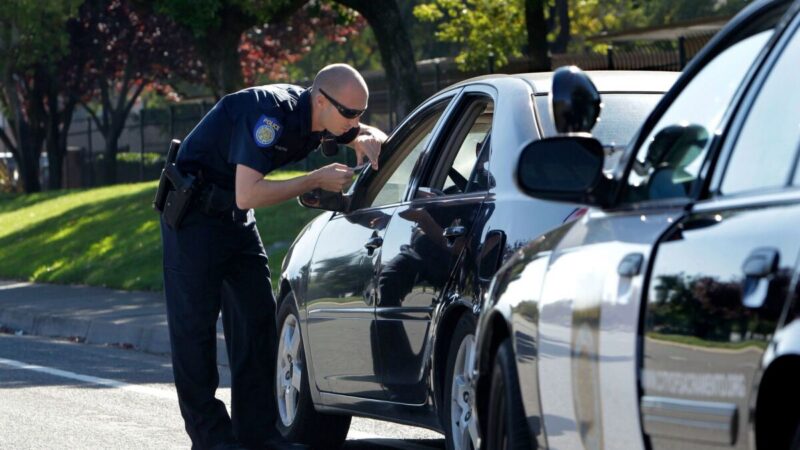
When a police officer stops a Black driver, the first 45 words said by that officer hold important clues about how their encounter is likely to go.
Car stops that result in a search, handcuffing, or arrest are nearly three times more likely to begin with the police officer issuing a command, such as “Keep your hands on the wheel” or “Turn the car off.”
That’s according to a new study in the Proceedings of the National Academy of Sciences that examined police body-camera footage of 577 routine car stops involving Black drivers.
Eighty-one of these stops ultimately involved searches, handcuffings, or arrests. That kind of outcome was less likely when a police officer’s first words provided a reason for the stop.
“The first 45 words, which is less than 30 seconds on average, spoken by a law enforcement officer during a car stop to a Black driver can be quite telling about how the stop will end,” says Eugenia Rho, a researcher at Virginia Tech.
[…]
To understand how Black men perceive the initial language used by police officers during a car stop, the researchers asked 188 Black men to listen to recordings of the opening moments of car stops.
It turns out, perhaps not surprisingly, those Black men were highly attuned to the implications of a police officer starting an interaction with a command.
“When officers began with orders without reasons, Black male participants predicted that the stop would escalate in over 84% of those cases,” says Rho.
And even though none of the stops in this study involved the use of force, Black men worried about the possibility of force 80% of the time when they heard a recording of a law enforcement officer issuing a command without offering a reason.
“In this country, we know much more about fearing Black people than the fears of Black people,” says [other researcher] Eberhardt. “Many Black people fear the police, even in routine car stops. That fear is a fear that could be stoked or set at ease with the first words that an officer speaks.”
Read more about this study in the original article.
Read this article to conceptualize the danger of traffic stops for Black Americans.
Read more Breaking News here.
Comments Are Welcome
Note: We moderate submissions in order to create a space for meaningful dialogue, a space where museum visitors – adults and youth –– can exchange informed, thoughtful, and relevant comments that add value to our exhibits.
Racial slurs, personal attacks, obscenity, profanity, and SHOUTING do not meet the above standard. Such comments are posted in the exhibit Hateful Speech. Commercial promotions, impersonations, and incoherent comments likewise fail to meet our goals, so will not be posted. Submissions longer than 120 words will be shortened.
See our full Comments Policy here.