Fear of a Black President
Share
Explore Our Galleries









Breaking News!
Today's news and culture by Black and other reporters in the Black and mainstream media.
Ways to Support ABHM?
By Ta-Nehisi Coates, The Atlantic
As a candidate, Barack Obama said we needed to reckon with race and with America’s original sin, slavery. But as our first black president, he has avoided mention of race almost entirely. In having to be “twice as good” and “half as black,” Obama reveals the false promise and double standard of integration.
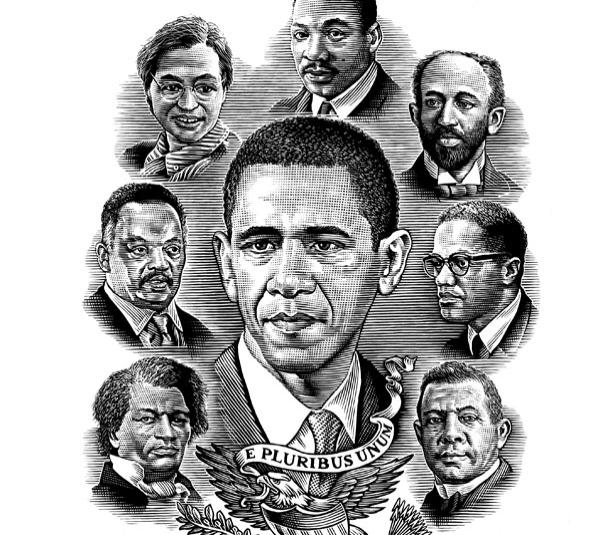
The irony of President Barack Obama is best captured in his comments on the death of Trayvon Martin, and the ensuing fray. Obama has pitched his presidency as a monument to moderation. He peppers his speeches with nods to ideas originally held by conservatives. He routinely cites Ronald Reagan. He effusively praises the enduring wisdom of the American people, and believes that the height of insight lies in the town square. Despite his sloganeering for change and progress, Obama is a conservative revolutionary, and nowhere is his conservative character revealed more than in the very sphere where he holds singular gravity—race.
The irony of Barack Obama is this: he has become the most successful black politician in American history by avoiding the radioactive racial issues of yesteryear, by being “clean” (as Joe Biden once labeled him)—and yet his indelible blackness irradiates everything he touches. This irony is rooted in the greater ironies of the country he leads. For most of American history, our political system was premised on two conflicting facts—one, an oft-stated love of democracy; the other, an undemocratic white supremacy inscribed at every level of government. In warring against that paradox, African Americans have historically been restricted to the realm of protest and agitation. But when President Barack Obama pledged to “get to the bottom of exactly what happened,” he was not protesting or agitating. He was not appealing to federal power—he was employing it. The power was black—and, in certain quarters, was received as such.
No amount of rhetorical moderation could change this. It did not matter that the president addressed himself to “every parent in America.” His insistence that “everybody [pull] together” was irrelevant. It meant nothing that he declined to cast aspersions on the investigating authorities, or to speculate on events. Even the fact that Obama expressed his own connection to Martin in the quietest way imaginable—“If I had a son, he’d look like Trayvon”—would not mollify his opposition. It is, after all, one thing to hear “I am Trayvon Martin” from the usual placard-waving rabble-rousers. Hearing it from the commander of the greatest military machine in human history is another.
Read the rest of this powerful and thoughtful analysis here.
Comments Are Welcome
Note: We moderate submissions in order to create a space for meaningful dialogue, a space where museum visitors – adults and youth –– can exchange informed, thoughtful, and relevant comments that add value to our exhibits.
Racial slurs, personal attacks, obscenity, profanity, and SHOUTING do not meet the above standard. Such comments are posted in the exhibit Hateful Speech. Commercial promotions, impersonations, and incoherent comments likewise fail to meet our goals, so will not be posted. Submissions longer than 120 words will be shortened.
See our full Comments Policy here.