Family trees fill in the gaps for Black people seeking their ancestral roots
Share
Explore Our Galleries
Breaking News!
Today's news and culture by Black and other reporters in the Black and mainstream media.
Ways to Support ABHM?
By Curtis Bunn, NBC News
Black people have been able to connect with the past and give new agency to their identities through building family trees and researching their family histories.
Growing up in Philadelphia, Amber Jackson said she knew so little of her history that she felt disconnected from who she was.
“They didn’t teach you the history of Black people in school,” she said. “They kind of gave you the illusion that Black people just showed up after everything was put together.”
Attempts to learn about her family history from older relatives were futile, she said. “I could see the hurt in their faces. They didn’t want to talk about it,” Jackson said. “So, I let it go.”
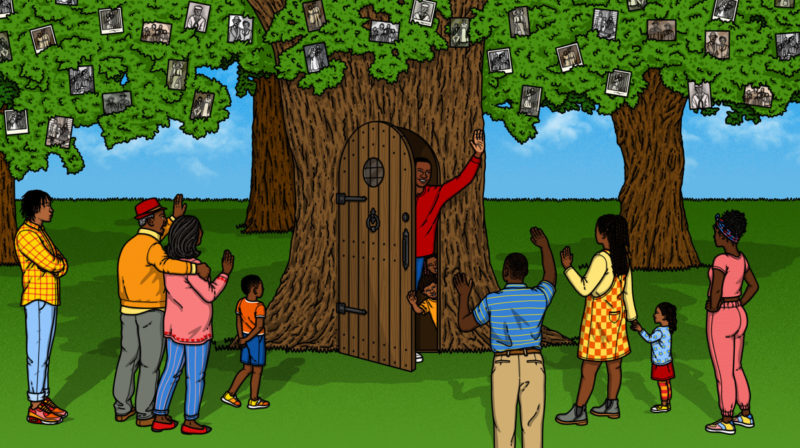
Eliana Rodgers for NBC News
Then she saw the 2002 movie “Antwone Fisher,” about a young sailor who had been in foster care and sought to learn more about his birth family. “And that’s when I was inspired to start my search to find mine, just like he did,” Jackson said.
She said she went through the Whitepages, as actor Derrick Luke had in the movie, and located her father’s sister almost instantly and called her, which led to more relatives. The findings inspired her to learn more, and Jackson pressed on, spending hours that turned into years building out her family tree through searching archives in libraries and research centers, scanning microfilm and, as technology advanced, using online services.
In 2021, after 19 years of probing, she struck Black family tree gold: an ancestral connection to the legendary abolitionist Harriet Tubman. Jackson learned that her great-great-grandmother was Jeanette Cornish, whose grandfather was Aaron Cornish, born in 1822 in Cambridge, Maryland — the same town as Tubman.
At 17, Aaron Cornish was among the 28 enslaved people Tubman led from the plantation on which they were kept. They would later be called the Cambridge 28, famous for the size of the group that escaped to freedom while carrying weapons to defend themselves, if necessary, and enduring three days of torrential rain.
The revelation elevated her self-esteem, she said, giving her a sense of self that had previously been absent.
“First, I felt pride bursting out of every pore,” she said. “Then, when I reread their story and what they went through, the emotion changed to an overwhelming hurt and sympathy for my family, imagining what my great-grandmother, Daffney, had to endure, giving birth during the escape and having enough faith and intestinal fortitude to push forward for not just her and her husband but her children. I am blown away by their strength.”
Jackson’s story underscores the surge in Black people using various means to increase their connection to family members who came before them as a way of bolstering their identity. The discovery of bloodlines generates a sense of self that can be profound — and can even alter how Black people look at themselves, Jackson said.
“Remember, Black families were separated purposefully to delete and separate any sort of throughline, any sort of emotional connection,” said Donald Grant, a clinical psychologist and the executive director of Mindful Training Solutions, a consulting firm in Los Angeles that specializes in wellness and behavioral health. “And so, because those things were deliberately severed, a lot of Black people are getting catharsis by identifying these connections that were taken from them. These search options are providing people with opportunities to get tangible examples of their historical resilience. White people have stories about their heritage in newspapers and in textbooks that support white superiority and ideology. Black people have to find information to build that history, that pride.”
Read the full article here.
More Breaking News here.
Comments Are Welcome
Note: We moderate submissions in order to create a space for meaningful dialogue, a space where museum visitors – adults and youth –– can exchange informed, thoughtful, and relevant comments that add value to our exhibits.
Racial slurs, personal attacks, obscenity, profanity, and SHOUTING do not meet the above standard. Such comments are posted in the exhibit Hateful Speech. Commercial promotions, impersonations, and incoherent comments likewise fail to meet our goals, so will not be posted. Submissions longer than 120 words will be shortened.
See our full Comments Policy here.