Early Novel Written By Free Black Woman Called Out Racism Among Abolitionists
Share
Explore Our Galleries









Breaking News!
Today's news and culture by Black and other reporters in the Black and mainstream media.
Ways to Support ABHM?
By Joe Rodolico, NPR
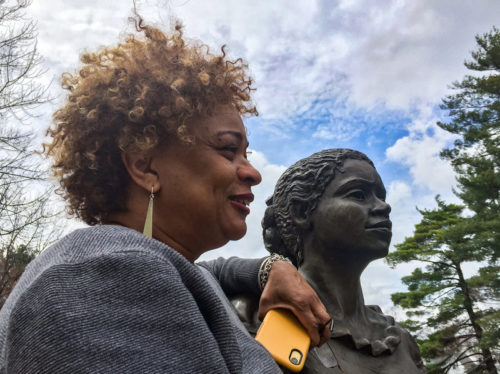
(Jack Rodolico /New Hampshire Public Radio)
Editor’s note: This report contains a racial slur.
Here’s one thing historians know to be true about Harriet Wilson: Some indomitable part of her spirit allowed her to survive a life on the margins of American society.
In 1859, Wilson published a book that she gave a provocative title: Our Nig. That name is a derivative of a racist nickname given to the book’s protagonist, a little girl of mixed race who grows up as an indentured servant to a white family. The girl is tortured by the family matriarch, beaten and forced to sleep in a frigid crawl space. Even the kindest members of the family call her “nig.”
“Some of the things she wrote in her book were shocking,” says JerriAnne Boggis, founder and director of The Harriet Wilson Project. “But it’s not any more shocking than anything that you didn’t know about slavery. It was shocking that it happened in the North because that’s not our story. Our story is the abolitionist movement.”
Wilson’s book called out racism among abolitionists in the North. It’s also emblematic of how important pieces of African American history can be forgotten — and then rediscovered.
In the novel, Wilson did not say much about the story’s setting or about herself. But Our Nig‘s long subtitle gave clues historians would later pick apart: “Sketches from the Life of a Free Black in a Two-Story White House, North; Showing That Slavery’s Shadow Falls Even There.“
Full article here
More Breaking News here
See more ABHM galleries here
Comments Are Welcome
Note: We moderate submissions in order to create a space for meaningful dialogue, a space where museum visitors – adults and youth –– can exchange informed, thoughtful, and relevant comments that add value to our exhibits.
Racial slurs, personal attacks, obscenity, profanity, and SHOUTING do not meet the above standard. Such comments are posted in the exhibit Hateful Speech. Commercial promotions, impersonations, and incoherent comments likewise fail to meet our goals, so will not be posted. Submissions longer than 120 words will be shortened.
See our full Comments Policy here.