Congress approves removing statue of Supreme Court chief justice who wrote Dred Scott decision
Share
Explore Our Galleries









Breaking News!
Today's news and culture by Black and other reporters in the Black and mainstream media.
Ways to Support ABHM?
By Zoë Richards, NBC News
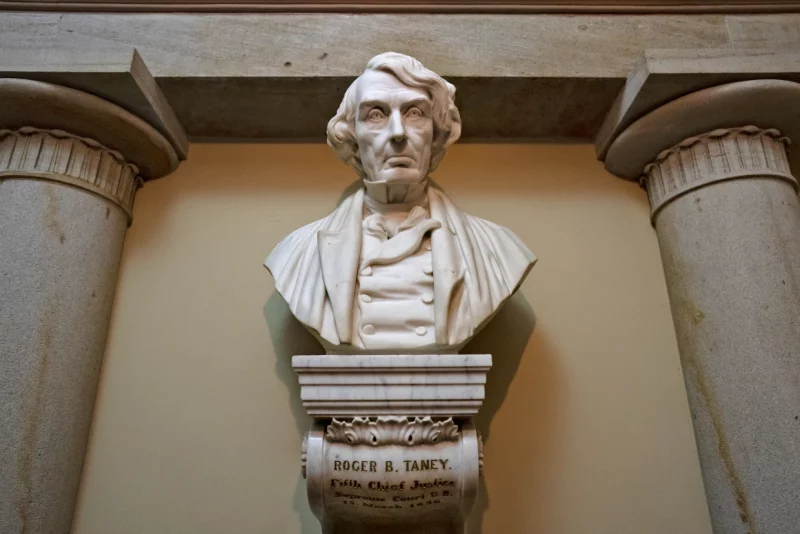
The House passed a bill Wednesday that would remove from public display at the U.S. Capitol a statue of Supreme Court Chief Justice Roger Taney, who wrote the 1857 Dred Scott decision, which defended slavery and denied the citizenship of Black Americans.
The legislation, which the House passed by voice vote, declares that Taney’s authorship of the decision “renders a bust of his likeness unsuitable for the honor of display to the many visitors to the Capitol.”
“While the removal of Chief Justice Roger Brooke Taney’s bust from the Capitol does not relieve the Congress of the historical wrongs it committed to protect the institution of slavery, it expresses Congress’s recognition of one of the most notorious wrongs to have ever taken place in one of its 19 rooms,” the bill states.
The measure directs the Joint Committee of Congress on the Library to remove Taney’s bust, which sits inside the entrance to the Old Supreme Court Chamber in the Capitol, and replace it with a bust of Thurgood Marshall, the court’s first Black justice.
The Senate passed the bill last week by unanimous consent. It now heads to President Joe Biden’s desk for his signature.
Learn about this bill’s journey.
Racist beliefs like those of Taney have contributed to pervasive racial stereotypes.
Comments Are Welcome
Note: We moderate submissions in order to create a space for meaningful dialogue, a space where museum visitors – adults and youth –– can exchange informed, thoughtful, and relevant comments that add value to our exhibits.
Racial slurs, personal attacks, obscenity, profanity, and SHOUTING do not meet the above standard. Such comments are posted in the exhibit Hateful Speech. Commercial promotions, impersonations, and incoherent comments likewise fail to meet our goals, so will not be posted. Submissions longer than 120 words will be shortened.
See our full Comments Policy here.