Central Park gate honors wrongly imprisoned ‘Exonerated 5’
Share
Explore Our Galleries









Breaking News!
Today's news and culture by Black and other reporters in the Black and mainstream media.
Ways to Support ABHM?
By Ted Shaffrey and Bobby Caina Calvin, Associated Press
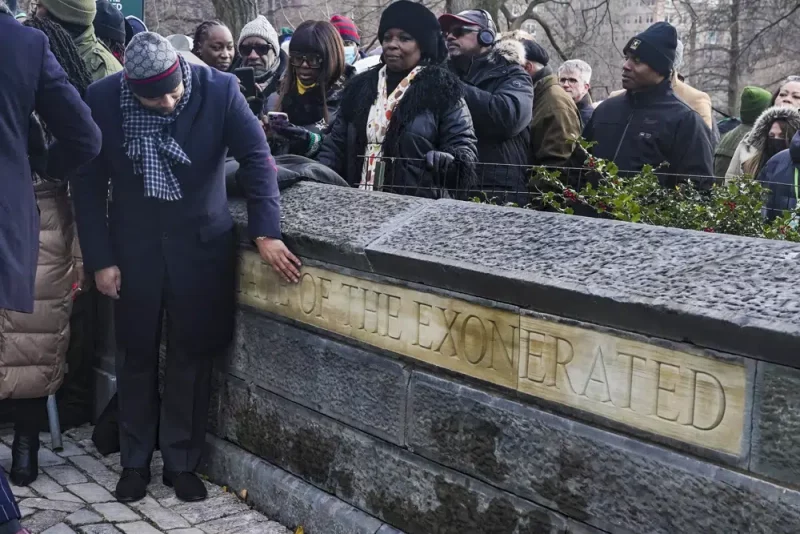
NEW YORK (AP) — At a small patch of Central Park flanking New York’s Harlem neighborhood, scores came Monday to remember the injustice that imprisoned five Black and Latino teenagers after they were wrongly accused and convicted of the 1989 rape of a white jogger.
They arrived in the chill of a late fall morning, some singing hymns, to dedicate a park entry to the men once known as the Central Park Five, but now remembered as the Exonerated Five.
The entryway, located on the northern perimeter of the park between Fifth Avenue and Malcolm X Boulevard, will be known as the “Gate of the Exonerated.” It commemorates the miscarriage of justice that not only befell the five men, organizers say, but the unknown others who might have been wrongly imprisoned.
“This is a moment. This is legacy time,” said one of the men, Yusef Salaam.
“We are here because we persevere,” he said to a cheering crowd.
Monday was the first time Raymond Santana, another of the men, now in his 40s, has returned to Central Park since that fateful day 33 years ago.
Santana was 14 and Salaam was 16 when they and three others — Kevin Richardson, 14; Korey Wise, 16; and Antron McCray, 15 — were wrongly tried for the rape of a 28-year-old woman, whose brutal attack left her with permanent injuries and no memory of the assault. The high-profile incident prompted police to round up Black and Brown men and boys in connection with the rape.
[…]
The three men — Wise and McCray could not attend — spoke about how the criminal justice system is stacked against people of color.
The gate, they said, would stand as reminder of the injustice of the past but also of those still being committed today.
APnews.com has video of the event.
The five men have since been honored, but exoneration from a system perpetuating racism poses other difficulties.
Keep up to date with other Black community and culture news.
Comments Are Welcome
Note: We moderate submissions in order to create a space for meaningful dialogue, a space where museum visitors – adults and youth –– can exchange informed, thoughtful, and relevant comments that add value to our exhibits.
Racial slurs, personal attacks, obscenity, profanity, and SHOUTING do not meet the above standard. Such comments are posted in the exhibit Hateful Speech. Commercial promotions, impersonations, and incoherent comments likewise fail to meet our goals, so will not be posted. Submissions longer than 120 words will be shortened.
See our full Comments Policy here.