Cabs wouldn’t pick her up. She became an award-winning journalist anyway.
Share
Explore Our Galleries









Breaking News!
Today's news and culture by Black and other reporters in the Black and mainstream media.
Ways to Support ABHM?
By Natasha S. Alford, theGrio.com
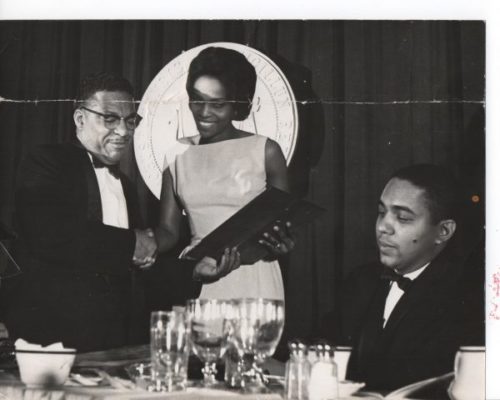
Dorothy Butler Gilliam received the JET Magazine Award in 1964. (Courtesy photo)
In 1961, Dorothy Butler Gilliam defied the odds by becoming the first Black woman reporter at The Washington Post.
At a time when Black people — let alone Black women — were not expected to have bylines in national papers, Gilliam was breaking down barriers, writing stories about the civil rights movement and the everyday lives of Black people.
While today we have Soledad O’Brien, Jemele Hill, April Ryan and Nikole Hannah-Jones, Gilliam’s career started when there weren’t many other Black women in mainstream media to look to for inspiration.
We met Gilliam in her Washington, D.C. home, where she still writes, this time telling her own story in a memoir called “Trailblazer: A Pioneering Journalist’s Fight to Make the Media Look More Like America….”
Despite racism and sexism, Gilliam went on to have a successful nationally syndicated column and help lead The Washington Post’s style section as Assistant Editor.
“One of the things I wanted to do was to share with all of the readers of The Post some of the great things about black culture. Because with the segregation everything was separate. I wanted to share [about] Blacks who were able to rise above segregation….”
Read the full article here
Read more Breaking News here
View more galleries from ABHM here
Comments Are Welcome
Note: We moderate submissions in order to create a space for meaningful dialogue, a space where museum visitors – adults and youth –– can exchange informed, thoughtful, and relevant comments that add value to our exhibits.
Racial slurs, personal attacks, obscenity, profanity, and SHOUTING do not meet the above standard. Such comments are posted in the exhibit Hateful Speech. Commercial promotions, impersonations, and incoherent comments likewise fail to meet our goals, so will not be posted. Submissions longer than 120 words will be shortened.
See our full Comments Policy here.