Black Women Sweep Local Elections in Small Towns
Share
Explore Our Galleries









Breaking News!
Today's news and culture by Black and other reporters in the Black and mainstream media.
Ways to Support ABHM?
By Aallyah Wright, CapitalB
Millennial candidates made sweeping gains in rural towns and small cities — making history and achieving several firsts.
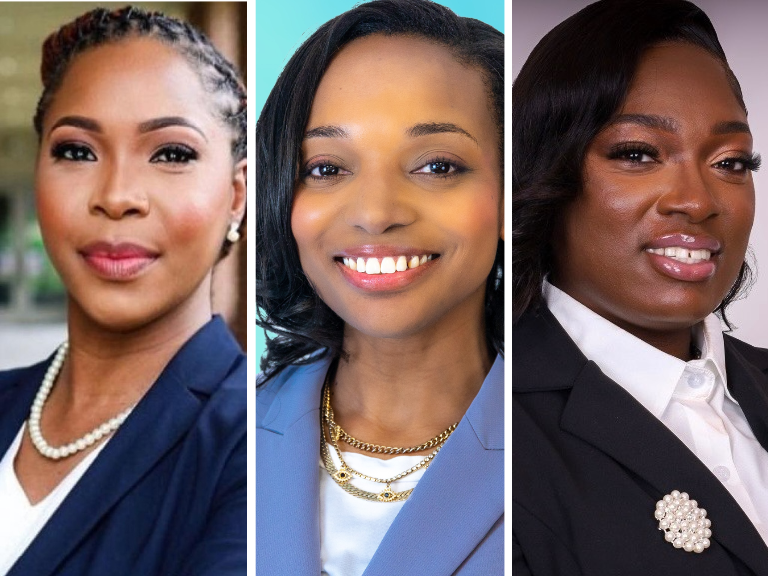
Deondreze Young hadn’t planned on a career in politics.
But, when seats opened up on her hometown city council, her father encouraged her to run, and she did, in hopes of making change in Wadley, Georgia.
Young’s roles and position in the community — as a cosmetology instructor, nail technician, substitute teacher, and mother — uniquely qualified her to help her community, she said.
For years, residents in the majority-Black town of fewer than 2,000 people have complained about the discolored water that runs from their faucets. It stains their hair and clothes, and the water is undrinkable. The smell is unfathomable. Young was tired of it, too. Although the city is working on upgrades to replace rusted water lines and renovate a sewer treatment plant, it will take time to complete.
“You have to double up on bottled water because we can’t drink our water,” she said.
On Nov. 4, she drove 10 miles away to a local polling location and found out she had become the youngest woman to be elected as a City Council member.
Last week, as the nation focused on New York City’s mayoral election and gubernatorial races in New Jersey and Virginia, there was an intergenerational movement of Black people in small cities and rural towns shaking up local elections, too. Democrats secured major victories, also dominating in state houses like in Mississippi, where Democrats broke a Republican supermajority in the Senate. Election Day wins for non-career politicians in local elections are a partial response to voter disillusionment with the federal government.
Whether it’s Roxboro, North Carolina, or Vineyard, Utah, everyday Black people aren’t waiting for progress to come to them, but driving it themselves and redefining what political power looks like outside of major cities.
Young, 35, believes the fire she’s seeing in her town, and across the country, is partially a response to the Trump administration’s decisions, and it’s forced young people to step into their power – by running for offices or voting new people in.
“They’re tired. Let’s just be for real, it’s always on our backs as the Black people to endure, but it’s always on our backs as well to make the change, to inspire the change,” she said. “We didn’t show up in protest. We showed up at the polls.”
Learn how these feelings contributed to record turnout in certain elections.
We similarly saw Black politicians step up during Reconstruction.
Comments Are Welcome
Note: We moderate submissions in order to create a space for meaningful dialogue, a space where museum visitors – adults and youth –– can exchange informed, thoughtful, and relevant comments that add value to our exhibits.
Racial slurs, personal attacks, obscenity, profanity, and SHOUTING do not meet the above standard. Such comments are posted in the exhibit Hateful Speech. Commercial promotions, impersonations, and incoherent comments likewise fail to meet our goals, so will not be posted. Submissions longer than 120 words will be shortened.
See our full Comments Policy here.