Black Women Leaders, Then And Now
Share
Explore Our Galleries









Breaking News!
Today's news and culture by Black and other reporters in the Black and mainstream media.
Ways to Support ABHM?
By Robert Greene II, Public Books
In August 1966, Ebony magazine published an entire issue devoted to “The Negro Woman.” In it was an article by television personality and journalist Ponchitta Pierce that addressed the “Problems of the Negro Woman Intellectual,” a year before Harold Cruse would release a book describing the “crisis” of Negro intellectuals. She began by writing, “The Negro woman intellectual is easily one of the most misunderstood, underappreciated and problem-ridden of all God’s creatures.”
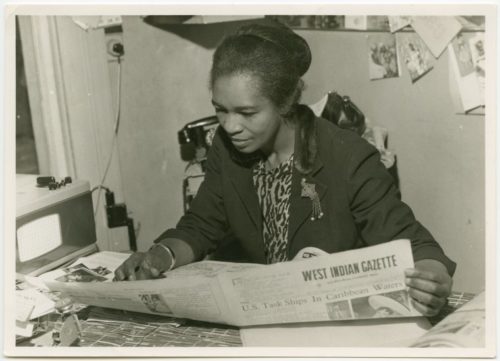
Just as the Black Power Movement was getting underway, following Stokely Carmichael’s impassioned call in Mississippi just two months before, the readers of Ebony were treated to a rare essay detailing the struggles of African American women as intellectuals. Female-identified people such as Gwendolyn Brooks, Pauli Murray, and Dorothy Height populate the essay, but it also could have included others such as the communist intellectual Claudia Jones or the Black Panther Kathleen Cleaver.
[…]
The recorded history of 20th-century American radicalism has, until recently, left out many important voices. However, of late, numerous historians have utilized seldom-accessed archives and new interpretative frameworks to emphasize the centrality of African American women to left movements in American—and international—history. Robyn C. Spencer’s The Revolution Has Come and Ashley D. Farmer’s Remaking Black Power have added immensely to understanding how African American women played a crucial role in the rise and continuation of what is called the “Black Radical Tradition.” After reading these books, it becomes clear that the Black Radical Tradition, and its ties to the worldwide tradition of radicalism, would not exist without the work and leadership of African American women.

Such work is urgent today—the Black Lives Matter movement, for example, makes little sense unless one understands the centrality of African American women to African American organizing. In fact, the Black Lives Matter website features a section titled “Herstory,” which reminds readers that the original founders of the movement were all women: Alicia Garza, Patrisse Cullors, and Opal Tometi.
Future histories of the Black Lives Matter campaign will talk about the feminist and queer ideologies at its center. “As a network,” BLM’s website reads, “we have always recognized the need to center the leadership of women and queer and trans people.” But, to understand BLM as it exists today, we need to realize that African American women have long been at the forefront of radical activism, organizing, and theorizing. Remaking Black Power and The Revolution Has Come both argue that the history of black radical thought cannot be understood without centering black women.
Read the full article here.
Read more Breaking News here.
View more galleries from ABHM here.
Comments Are Welcome
Note: We moderate submissions in order to create a space for meaningful dialogue, a space where museum visitors – adults and youth –– can exchange informed, thoughtful, and relevant comments that add value to our exhibits.
Racial slurs, personal attacks, obscenity, profanity, and SHOUTING do not meet the above standard. Such comments are posted in the exhibit Hateful Speech. Commercial promotions, impersonations, and incoherent comments likewise fail to meet our goals, so will not be posted. Submissions longer than 120 words will be shortened.
See our full Comments Policy here.