Black female college athletes are center stage at this sports agency
Share
Explore Our Galleries









Breaking News!
Today's news and culture by Black and other reporters in the Black and mainstream media.
Ways to Support ABHM?
By Curtis Bunn, NBC News
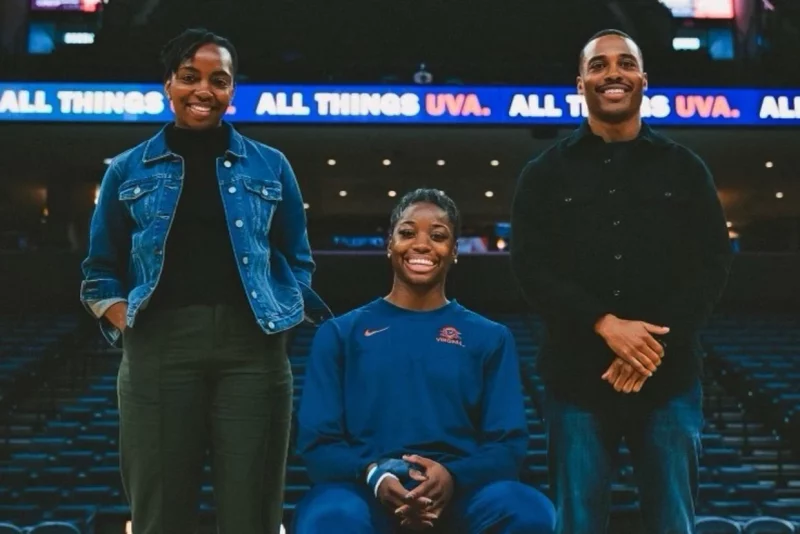
University of Virginia women’s basketball player Mir McLean admits she was slow to respond to an email from Solace Sports and Entertainment co-founder Folasade Omogun-Broadnax about becoming a potential client. But when she finally spoke to Omogun-Broadnax a couple of days later about being the face of her sports agency centered on Black female college athletes, McLean said she felt an immediate connection.
“As a Black woman, I feel more connected to her versus someone else,” McLean said. “It’s really important for Black athletes to have that kind of representation because it provides another sense of protection. I don’t feel used. I don’t have to second-guess what’s best for me because I know that’s what she’s looking for — the best for me.”
That’s exactly what Omogun-Broadnax and her Solace partner, Terence Davis, set out to do with their company. The pair of 33-year-old attorneys, who served as clerks in the same circuit court in Maryland, talked for years about creating an agency that could advance the careers of Black female athletes.
Their plan was to focus on Black female college athletes, securing more exposure and endorsement deals following the NCAA’s new name, image and likeness, or NIL, policy that allows players to be compensated.
“Black female athletes are some of the most talented human beings on this planet,” Omogun-Broadnax said. “Yet, they are often overlooked for partnership opportunities that would help grow and advance their brands and careers.”
Before the NIL ruling in 2021, sports programs generated billions of dollars, but the athletes who competed were not able to receive payment.
School and athletic programs were enriched, but the players, many from families with financial challenges, received nothing or faced disqualification if they brokered a deal. Now, top college athletes have the opportunity to profit for the first time in NCAA history.
With their newly launched company, Omogun-Broadnax and Davis hoped to bring their personal touch, attention and passion to their clients. Omogun-Broadnax, a former criminal defense lawyer, even quit her most recent job as a litigator to lead the sports component of the company, while Davis, a personal injury lawyer, heads up the entertainment arm of Solace, based in Northern Virginia.
Athletics is one arena that can contribute to economic justice. Unfortunately, income inequality is far-reaching.
Check out ABHM’s breaking news page.
Comments Are Welcome
Note: We moderate submissions in order to create a space for meaningful dialogue, a space where museum visitors – adults and youth –– can exchange informed, thoughtful, and relevant comments that add value to our exhibits.
Racial slurs, personal attacks, obscenity, profanity, and SHOUTING do not meet the above standard. Such comments are posted in the exhibit Hateful Speech. Commercial promotions, impersonations, and incoherent comments likewise fail to meet our goals, so will not be posted. Submissions longer than 120 words will be shortened.
See our full Comments Policy here.