Black Art and Poetry Elevate a Tribute to Civil Rights Leaders
Share
Explore Our Galleries









Breaking News!
Today's news and culture by Black and other reporters in the Black and mainstream media.
Ways to Support ABHM?
In “The Baptism,” Carrie Mae Weems and Carl Hancock Rux find an abstract, elegiac voice in their video honoring John Lewis and C.T. Vivian.
By Maya Phillips, The New York Times
During the last several months, between the scourge of Covid-19 and the spate of Black deaths resulting from police brutality, Blackness has become a concept loaded with fresh injuries. In “The Baptism,” a short, abstract video tribute to Representative John Lewis and the civil rights leader C.T. Vivian, Blackness isn’t divorced from the tragedies but carefully picked apart and examined through an existential lens. The result is a work that is freeing and radical in a way that Black art so often doesn’t get to be.
Commissioned by Lincoln Center, “The Baptism” features a three-part poem written and performed by the poet Carl Hancock Rux, and is directed by the acclaimed visual artist Carrie Mae Weems.
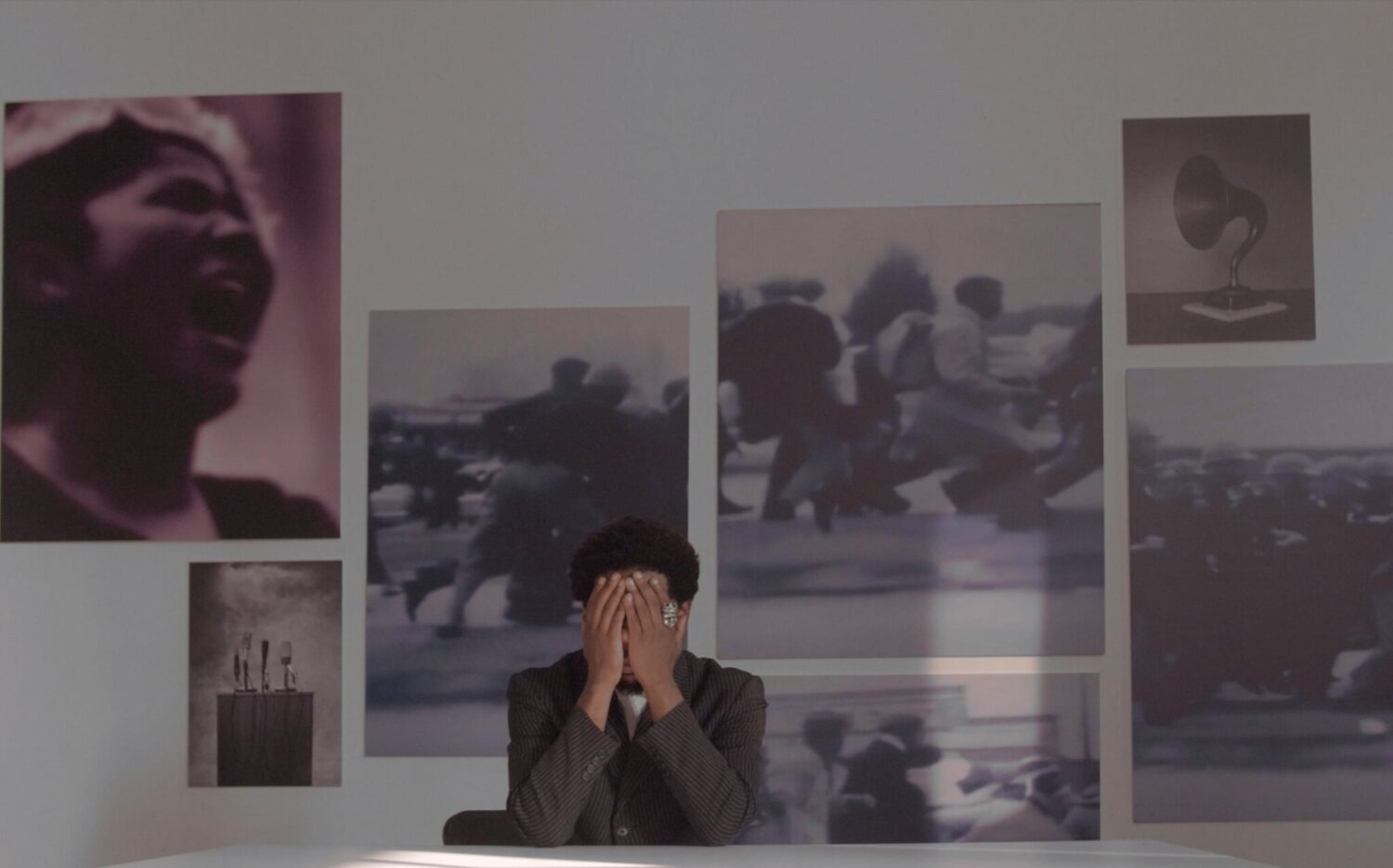
Carl Hancock Rux, a black poet, in front of several pieces of art
…Mr. Rux’s piece, a meditative prose poem split into three sections, refers to Lewis and Vivian as “the sharecropper’s son” and “the boy from Booneville,” respectively. There are hints of death everywhere in the piece — a parable about japonica flowers that have “died in the frost,” the withering body, the decomposing tissue of the corpse, the inviting soil….
…Conceptually the piece feels like a cousin to Beyoncé’s recent visual poem, “Black Is King,” which also relished abstraction, drawing from sound and imagery and metaphor to define Blackness positively and holistically. Though plenty of Black movements have touted an essential theme of self-determination in their works — the Black Arts movement, Afrofuturism — it is still novel to have visible artwork that aims to dissect Blackness on an existential level, with lyrical ruminations. Of course, this has long been a hallmark of Ms. Weems’s photo installations, which are contemplative and stunningly poetic in their depictions of Black life. And it’s something white filmmakers have been so comfortable with in movies like “The Tree of Life” or even “Being John Malkovich,” philosophically interrogating humanity and human identity when whiteness is the default.
Read the full article here
Learn more about black poetry and civil rights here and here
More Breaking News here
Comments Are Welcome
Note: We moderate submissions in order to create a space for meaningful dialogue, a space where museum visitors – adults and youth –– can exchange informed, thoughtful, and relevant comments that add value to our exhibits.
Racial slurs, personal attacks, obscenity, profanity, and SHOUTING do not meet the above standard. Such comments are posted in the exhibit Hateful Speech. Commercial promotions, impersonations, and incoherent comments likewise fail to meet our goals, so will not be posted. Submissions longer than 120 words will be shortened.
See our full Comments Policy here.