Beloved Black-owned bookstore in Pasadena becomes a safe haven for fire victims
Share
Explore Our Galleries









Breaking News!
Today's news and culture by Black and other reporters in the Black and mainstream media.
Ways to Support ABHM?
By Char Adams and Ellison Barber, NBC
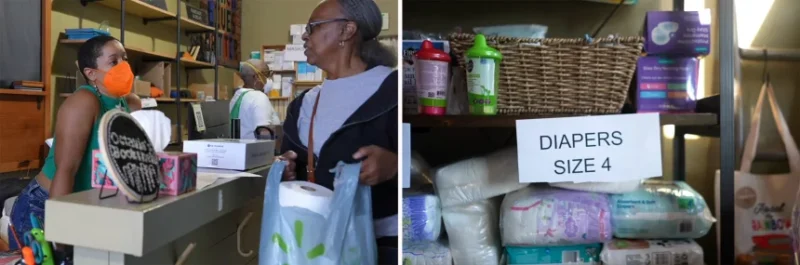
PASADENA, Calif. — Usually, Octavia’s Bookshelf in Pasadena, California, is filled with books. The walls are lined with titles on dark brown shelves, and customers can buy candles and other small goods, too. But for the past two weeks, the Black-owned bookshop has been packed wall-to-wall with supplies like bottles of water, hygiene products, clothes and food that are given away for free to locals impacted by the ongoing wildfire in the area.
“The focus has always been serving the community and that means different things at different times. Right now it means something other than books,” Kiki Williams, manager of the bookstore, said.
Overall, the multiple fires in Souther California have killed at least 27 people and dozens more may be missing. The Eaton Fire, which has ravaged parts of Pasadena and Altadena, was 65% contained as of Friday morning.
Nikki High, the owner of the bookstore, returned to the shop last week and was shocked to learn that the building still had power. High, who has been unable to return to her Pasadena home, immediately opened the store to displaced locals who needed to charge their phones, use their laptops and connect with their loved ones. Williams recalled the moment the simple bookstore grew into more.
“Somehow, in the midst of all that, people just started to bring stuff,” Williams said. “And then within a few hours, I looked at Nikki and I said, ‘Nikki, we have an operation happening.’”
Overnight, the bookshop was transformed into a resource center, a mutual aid hub where locals could use the store’s power and access everything from blankets and baby supplies to hot food and water. With the help of volunteers, employees have been able to distribute supplies to the elderly, disabled or otherwise vulnerable people. For the last week, the store’s Instagram account has been filled with updates and invitations for locals to come and access anything they may need.
NBC has more details.
Discover Black history in our galleries.
Comments Are Welcome
Note: We moderate submissions in order to create a space for meaningful dialogue, a space where museum visitors – adults and youth –– can exchange informed, thoughtful, and relevant comments that add value to our exhibits.
Racial slurs, personal attacks, obscenity, profanity, and SHOUTING do not meet the above standard. Such comments are posted in the exhibit Hateful Speech. Commercial promotions, impersonations, and incoherent comments likewise fail to meet our goals, so will not be posted. Submissions longer than 120 words will be shortened.
See our full Comments Policy here.