At Milwaukee’s Kinship Cafe, new beginnings are on the menu
Share
Explore Our Galleries









Breaking News!
Today's news and culture by Black and other reporters in the Black and mainstream media.
Ways to Support ABHM?
By Nick Rommel, WPR
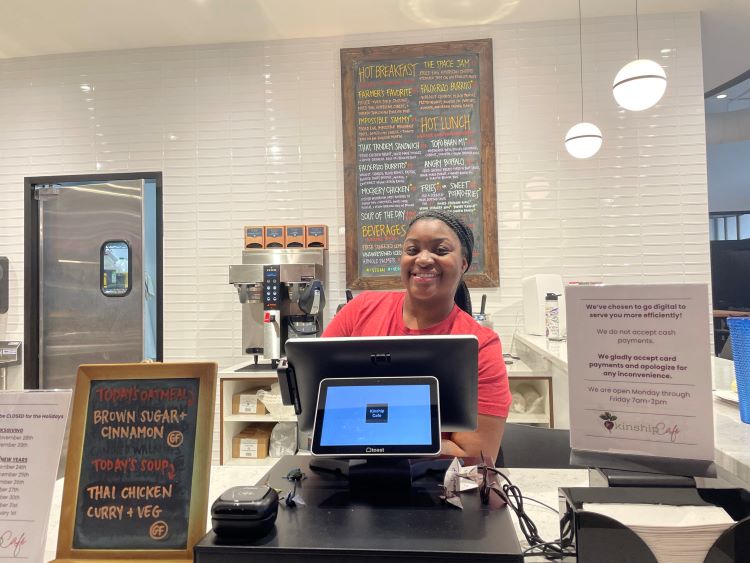
One spring day in 2023, Mattie Allen went for a walk, praying for a miracle.
Her adoptive parents had disowned her, she was battling for custody of her kids and facing possible homelessness. Passing St. Casimir’s Church in Milwaukee’s Riverwest neighborhood, she noticed a sign for the Kinship Community Food Center.
Having previously been a logistics manager for 16 years, she could tell the pantry was “well put-together.” But the first thing she did was volunteer.
“Even though I needed help, I went to help,” Allen said.
She now works at the new Kinship Cafe, which was opened by the food center in November on Milwaukee’s north side. It’s staffed by participants in Kinship’s workforce program, like Allen.
The yearlong program invites eight to 12 participants annually, according to Amanda Fahrendorf, Kinship’s senior communications associate. They’re usually people who have been involved at the food pantry as shoppers or volunteers.
Fahrendorf said it has a “therapeutic lens,” pairing work experience with counseling sessions.
“It’s through healing that people can achieve their next goal in life,” she said.
For Allen, the program has made a deep impact. She said it helped her “reframe” assumptions she had about her life.
“It’s almost like you’re starting from an infant again,” she said. “And you’re able to recreate the world that works for you.”
Keep reading to discover other comparisons of kinship’s impact.
Discover Milwaukee’s relationship with race.
Comments Are Welcome
Note: We moderate submissions in order to create a space for meaningful dialogue, a space where museum visitors – adults and youth –– can exchange informed, thoughtful, and relevant comments that add value to our exhibits.
Racial slurs, personal attacks, obscenity, profanity, and SHOUTING do not meet the above standard. Such comments are posted in the exhibit Hateful Speech. Commercial promotions, impersonations, and incoherent comments likewise fail to meet our goals, so will not be posted. Submissions longer than 120 words will be shortened.
See our full Comments Policy here.