As innocent Black men wait in prison to be exonerated, their families share the toll
Share
Explore Our Galleries









Breaking News!
Today's news and culture by Black and other reporters in the Black and mainstream media.
Ways to Support ABHM?
By Curtis Bunn, NBC News
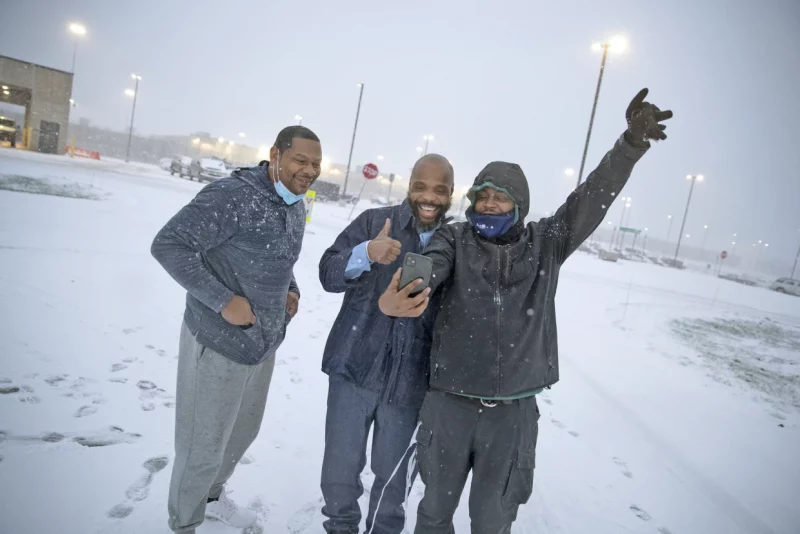
Tomekia Hicks-Gaskins was 29 when her brother, Termaine Hicks, went to prison for a rape he did not commit. She was 48 when he was exonerated and freed from prison. Over those 19 years, Hicks-Gaskins said she “aged a great deal — I felt like I was 40 years older.”
Now 50 and exhilarated that her brother has been home in Philadelphia for nearly two years, Hicks-Gaskins said the burden of her loved one being wrongfully convicted persists.
“It was hard,” she said as her eyes welled up with tears. “I hated going to prison to visit my brother. I had to keep a straight face for him. But it was hard leaving him there, knowing he was innocent. It took such a toll on me. It was the first time in my life I was skinny, I lost so much weight. There were financial burdens. There’s so much to how a family is thrown into turmoil that people don’t know with someone being wrongfully convicted.”
The Hicks family represent an often overlooked aspect of wrongful incarcerations and exonerations: that families suffer along with those wrongfully convicted. With every wrongful conviction, studies show that there are long-lasting ramifications that can span generations. And Black families are affected the most.
While Black Americans make up around 13% of the population, the National Registry of Exonerations say they account for 53% of the 3,266 exonerations in the registry. “And that means more Black families are impacted,” said Samuel Gross, the registry’s founder and senior editor. “It’s heartbreaking. They’re no happy endings with exonerations. Almost all had their lives deeply damaged. And … It’s devastating to families.”
Karen Thompson, a former attorney with the Innocence Project who now works with the American Civil Liberties Union of New Jersey, said that exonerations represent more than justice delayed, as Black families are already “deeply impacted.”
Learn how delayed exoneration impacts Black families.
Frustratingly, Black people are often wrongfully accused and have suffered greatly because of the war on drugs, but exoneration can also be traumatizing.
Comments Are Welcome
Note: We moderate submissions in order to create a space for meaningful dialogue, a space where museum visitors – adults and youth –– can exchange informed, thoughtful, and relevant comments that add value to our exhibits.
Racial slurs, personal attacks, obscenity, profanity, and SHOUTING do not meet the above standard. Such comments are posted in the exhibit Hateful Speech. Commercial promotions, impersonations, and incoherent comments likewise fail to meet our goals, so will not be posted. Submissions longer than 120 words will be shortened.
See our full Comments Policy here.