Artwork from the Black Lives Matter memorial has a new home: the Library of Congress
Share
Explore Our Galleries









Breaking News!
Today's news and culture by Black and other reporters in the Black and mainstream media.
Ways to Support ABHM?
By Jonathan Franklin, NPR
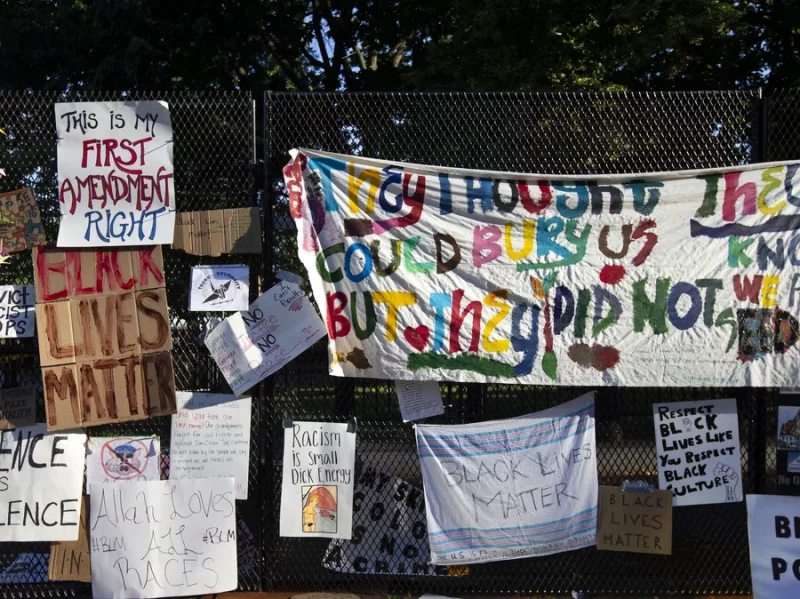
The fence that once stood between protesters and the White House at Lafayette Park during the summer of 2020 (also known as the Black Lives Matter memorial), displayed hundreds of signs, posters and artwork left by protesters following the murder of George Floyd.
While authorities took down the fence in early 2021, activists made it their mission to preserve every artifact — knowing that each sign represents a part of the nation’s history.
Now, thanks to the help of activists and archivists, the pieces of artwork that once served as a memorial of the movement are being displayed in a new online exhibit on the Library of Congress’ website.
According to the Library, more than 30 pieces of artwork are now available online.
“[The Library] wants people to see those signs, the messages and contextualize them with other parts of our collection that talk about similar issues,” said Aliza Leventhal, head of technical services for the prints and photography division of the Library of Congress.
Keep reading to discover how these works of art found a new home here.
Check out our exhibit on June Jordan, who used poetry as activism.
More Breaking News here.
Comments Are Welcome
Note: We moderate submissions in order to create a space for meaningful dialogue, a space where museum visitors – adults and youth –– can exchange informed, thoughtful, and relevant comments that add value to our exhibits.
Racial slurs, personal attacks, obscenity, profanity, and SHOUTING do not meet the above standard. Such comments are posted in the exhibit Hateful Speech. Commercial promotions, impersonations, and incoherent comments likewise fail to meet our goals, so will not be posted. Submissions longer than 120 words will be shortened.
See our full Comments Policy here.