America’s Black Holocaust Museum’s Grand Reopening Was a Celebration
Share
Explore Our Galleries









Breaking News!
Today's news and culture by Black and other reporters in the Black and mainstream media.
Ways to Support ABHM?
By Kenya C. Evans, Milwaukee Magazine
At long last, this important museum welcomed visitors again.
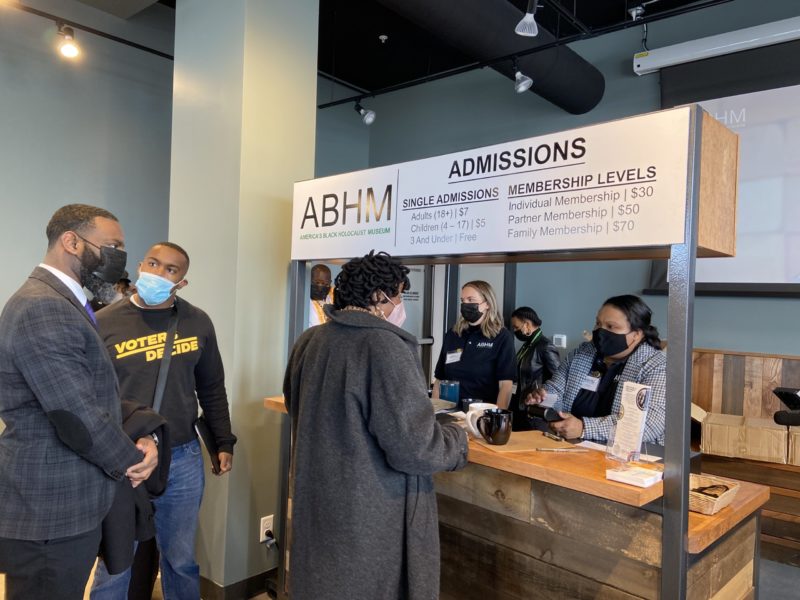
Droves of people flooded the white tent outside of America’s Black Holocaust Museum (401 W. North Ave.) Friday morning. Inside, supporters sheltered from the snow with excitement and pride as they got ready to celebrate the museum’s grand reopening and ribbon-cutting ceremony.
The slushy streets were covered with nearly five inches of snow – delaying a few of the scheduled speakers – but that couldn’t stop the successful kick-off of ABHM’s long-awaited festivities. The museum was founded in 1988 by the late James Cameron, a social activist and lynching survivor, to build “public awareness of the harmful legacies of slavery and Jim Crow in America and promotes racial repair, reconciliation, and healing.” The original location closed in 2008, and the museum has been operating virtually since 2012. After many years of dogged determination by museum supporters, Friday’s festivities marked its return to a physical space.
Among the attendees were dignitaries, Bronzeville neighbors, Milwaukee-area community members and a few Tuskegee University alumni in support of their good friend, Robert “Bert” Davis, the museum’s President and CEO.
“It’s like being on a long journey and actually getting to your destination. It’s exciting. It’s relief,” Davis said. “There’s been very little sleep for the last week, but I’m really grateful to see all the people that helped to make this happen. It’s a wonderful feeling.”
COO Chantel McKenzie hosted the ceremony, which began with a song by a local singer, prayer by Rev. Reginald Blount and poem by Kwabena Antoine Nixon. The poets emphatic words energized an already buzzing crowd: “We build our own schools, we breed our own scholars, we, holla-holla! We must rise. Holla-holla! We must rise.”
From there, a parade of speakers graced the stage and screens set up for a few surprise guests, including founding director of the Smithsonian Museum of African American Art and Culture Lonnie Bunch, president & CEO of the American Alliance of Museums Laura Lott and executive director of the Association of African American Museums Vedet Coleman-Robinson.

Bunch spoke to the importance of museums, which shine a light on “our dark corners of history.”
“It seems more important now as we see a nation divided,” Bunch said. “A nation that is actually beginning to pass laws to prevent people from looking at its history. Museums like [ABHM] are crucial because they are gathering spots where people can come and be educated, inspired. They are also places that ensure that we never forget.”
Federal, state and local officials, including Sen. Tammy Baldwin, Rep. Gwen Moore, Gov. Tony Evers and acting Mayor Cavalier Johnson, gave thanks and congratulations to museum staff and supporters. Virgil Cameron, the son of ABHM’s founder James Cameron spoke as well, along with Davis’ fellow alumni who gave remarks in his honor and awarded him a resolution from Tuskegee University recognizing his career accomplishments.
Davis closed the ceremony by elaborating on his plans to build upon Cameron’s original vision: “[to] create an academic center of excellence around the study of race, and then we would have scholars from around the country and around the world — students and scholars — that will come and share their knowledge with us and the entire world.’”

As the ceremony ended, people poured out onto the snowy avenue to witness the ribbon cutting by Virgil Cameron, Davis, board chair Ralph Hollman, developer Melissa (Goins) Allen and filmmaker-writer-producer Brad Pruitt, an essential player in the museum’s resurgence.
Attendees were then invited to visit the museum with free admission for the entire day of the opening. The line through the gallery snaked around the spacious hall as performing artist, Evan Christian, played live music while people hugged and took photos.
Catching a few of the first visitors leaving the gallery, I got their initial reactions.

Deidra Rodgers, of Milwaukee, was visiting with her daughter and husband:
“All the effort that it took, it was really inspiring. And then to actually go through and walk through, there were times where I had tears, there were times when I reflected, there were times I was proud. You know, ‘and still we rise’ is what was going through my head.”
Rodgers’ daughter gave her experience as well:
“I can’t really put words to how I felt when I went through the museum. There [were] times where I felt heavy. I felt confused. It was a really beautiful thing to learn about, but it was also really sad.”
Andrea Bernstein, of Bayside, shared:
“The museum is an incredible affirmation of dignity of the Black American history and Black American people. It’s incredible to just be part of it, especially on this historic day.”
In addition to the reopening, the day marked what would have been the 108th birthday of founder James Cameron, as well as the 10th anniversary of the virtual museum’s opening. While it was a long, invigorating morning full of celebration, many of the speakers also noted that, as a nation, there is still so much work to be done.
“It’s obviously an extraordinary day for the museum,” Pruitt said. “But more than that for this community, for this city, for this state, for this country, as a global partner and citizen, Dr. Cameron’s vision [was to] more comprehensively explore our collective American history as a cornerstone and a building block for reconciliation and healing. My hope today is that that message, and that spirit, and that energy reverberates around the world.”
Read the full story and see many more photos here.
Learn about why and how this museum was created by an 74 year old lynching survivor here.
More Breaking News here.
Comments Are Welcome
Note: We moderate submissions in order to create a space for meaningful dialogue, a space where museum visitors – adults and youth –– can exchange informed, thoughtful, and relevant comments that add value to our exhibits.
Racial slurs, personal attacks, obscenity, profanity, and SHOUTING do not meet the above standard. Such comments are posted in the exhibit Hateful Speech. Commercial promotions, impersonations, and incoherent comments likewise fail to meet our goals, so will not be posted. Submissions longer than 120 words will be shortened.
See our full Comments Policy here.