‘A perverse part of me likes to delve into what’s off-limits’: Somaya Critchlow on her taboo-breaking art
Share
Explore Our Galleries









Breaking News!
Today's news and culture by Black and other reporters in the Black and mainstream media.
Ways to Support ABHM?
By Chloë Ashby, The Guardian
She blends techniques from the old masters with imagery from 60s porn magazines – and it’s made her one of 2022’s most celebrated young painters
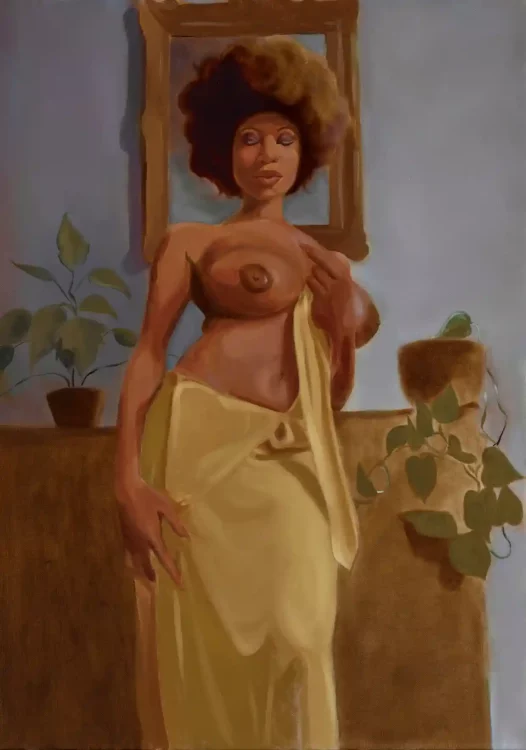
Somaya Critchlow knows that we’re supposed to be moving away from making images of naked female bodies. Bodies that are socially and sexually available. But her paintings express the appeal of stripping a figure bare. “People try to position my work as being sex-positive or political or whatever – and it’s not, it’s just investigative,” says the London-based artist, who is warm, open and softly spoken in the way that bright people often are. “I’m not trying to be an activist. But I do enjoy painting and I do enjoy my subject matter. Maybe that’s selfish.”
It seems to be working. This year, Critchlow’s small and intense portraits of curvy Black women in various stages of undress have featured in major group exhibitions across the UK and a solo show at Maximillian William gallery in London. Opening this weekend are a couple of shows she has curated at the Lightbox gallery in Woking – Lucian Freud and the Soul As Sphere – which are anchored around two of her great loves: figurative art and her grandfather, the late artist Keith Critchlow.
“I come from quite a creative family,” she says. Her mum had her when she was 20 and went back to art school when Critchlow was 10; she was a single parent and sometimes couldn’t get childcare, so she’d take her daughter with her. Critchlow’s grandmother was a quilter, her grandfather Keith a painter turned professor of architecture, writer and geometer. “They had this lovely house in Stockwell [south London], with a wooden studio at the end of the garden. My grandpa would be down there working and there would be a desk space where I’d sit and colour in geometric shapes.”
It was a strange sort of double existence, says Critchlow, “growing up as a Black girl in Streatham” and also being a part of this “fairly white and middle-class environment”. While her father is Nigerian, she spent most of her time with her mother’s family, all of whom she would describe as “white passing”, and who had white partners and children. They always encouraged her to do whatever she wanted, but as she got older she began to notice the attention people paid to the colour of her skin. Studying at Brighton University and then the Royal Drawing School in London, she also became aware that she was learning about the history of art and Black art as two separate entities. “And that there are certain subjects that as a Black artist you’re allowed to explore,” she says. “It made me feel uncomfortable.”
The same might be said of Critchlow’s art, which is bold and confrontational. “I think there’s a perverse part of me that likes to delve into subject matter that’s off-limits,” she says. When she painted a topless Black woman leaning on a pair of watermelons, alluding to a racist trope, the director of a US gallery asked her: “How could you?” “My feeling is how do things move forward unless we’re able to reimagine them?” she says. “I think to really understand and interrogate something you’ve got to get close to the area that you’re told is a no-go zone.”
Keep reading to learn more about Critchlow and her work.
Across the world, museum exhibits are challenging how people see Blackness.
More Black culture and art news here.
Comments Are Welcome
Note: We moderate submissions in order to create a space for meaningful dialogue, a space where museum visitors – adults and youth –– can exchange informed, thoughtful, and relevant comments that add value to our exhibits.
Racial slurs, personal attacks, obscenity, profanity, and SHOUTING do not meet the above standard. Such comments are posted in the exhibit Hateful Speech. Commercial promotions, impersonations, and incoherent comments likewise fail to meet our goals, so will not be posted. Submissions longer than 120 words will be shortened.
See our full Comments Policy here.