A new documentary explores why the first ‘Black Barbie’ was much more than just a doll
Share
Explore Our Galleries









Breaking News!
Today's news and culture by Black and other reporters in the Black and mainstream media.
Ways to Support ABHM?
By Kalia Nichols, CNN
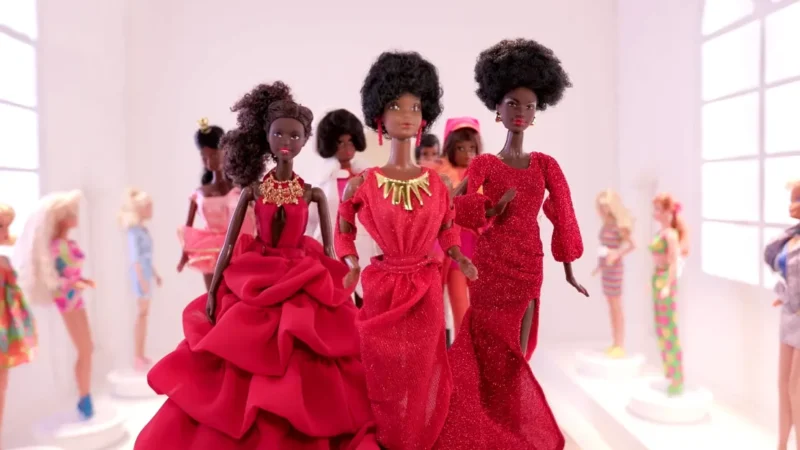
In the first few minutes of her new documentary film, the writer and director Lagueria Davis pays a visit to her aunt, Beulah Mitchell. At Mitchell’s house, they look through a room filled with boxes of dolls stacked up to the ceiling.
Davis — who says in the documentary she was far from a fan of dolls herself — was curious about why her aunt loved the toys so much, so when she discovered her aunt’s role in the creation of the first Black Barbie doll, she knew there was a story that needed to be told.
“Of course she had a story, so I wanted to jump right in after that,” Davis explained in an interview with CNN. And so she did: “Black Barbie: A Documentary,” her newly-released project, takes a deeper look at the story behind Black Barbie and its impact on representation in the toy business, and culture more broadly. The film features the stories of Black women who worked at Mattel, as well as appearances from Shonda Rhimes, ballerina Misty Copeland, Olympic fencer Ibtihaj Muhammad and Congresswoman Maxine Waters among others. Rhimes (whose production company, Shondaland, acquired the documentary at the SXSW Film Festival last year), Copeland and Muhammad have all had Barbies fashioned in their likeness.
Mitchell worked at Mattel for over four decades, starting her career at the company in 1955 on the assembly line — one of few Black Americans employed there at the time. As a child, she had been fascinated by dolls, she recalled in the documentary, but due to the lack of Black dolls at the time, it never occurred to her that she could have a Black doll specifically.
In 1960 or 1961, she encouraged Mattel founder Ruth Handler to create a Black Barbie doll — an “act of revolution,” UCLA professor Patricia A. Turner says in the documentary. (at the time, Handler replied, “we’ll see,” Mitchell remembered.)
While Mattel did later sell Black dolls like “Christie” and “Nurse Julia” in the late sixties, they were not Barbies. (Christie was billed as a side character in “Barbieland,” while Nurse Julia was a celebrity doll based on the actor and singer Diahann Carroll.) The actual Black Barbie doll didn’t become a reality until decades later, after the company hired Kitty Black Perkins in 1976 as its first Black designer.
Upon Black Barbie’s eventual release in 1980, it was clear Black Perkins’ design was the complete opposite of the Barbie people knew: full lips, wide nose, bold colors and a short afro.
“When I designed this doll, there was a need for the little Black girl to have something she could play with that looked like her,” Black Perkins says in the documentary. “I wanted her to reflect the total look of a Black woman.”
Modern Black Barbies have gotten makeovers from famous stylists.
Comments Are Welcome
Note: We moderate submissions in order to create a space for meaningful dialogue, a space where museum visitors – adults and youth –– can exchange informed, thoughtful, and relevant comments that add value to our exhibits.
Racial slurs, personal attacks, obscenity, profanity, and SHOUTING do not meet the above standard. Such comments are posted in the exhibit Hateful Speech. Commercial promotions, impersonations, and incoherent comments likewise fail to meet our goals, so will not be posted. Submissions longer than 120 words will be shortened.
See our full Comments Policy here.