Ferguson Activists Predict Uphill Battle
Share
Explore Our Galleries




Breaking News!
Today's news and culture by Black and other reporters in the Black and mainstream media.
Ways to Support ABHM?
By Ryan J. Reilly and Jennifer Bendery, HuffingtonPost
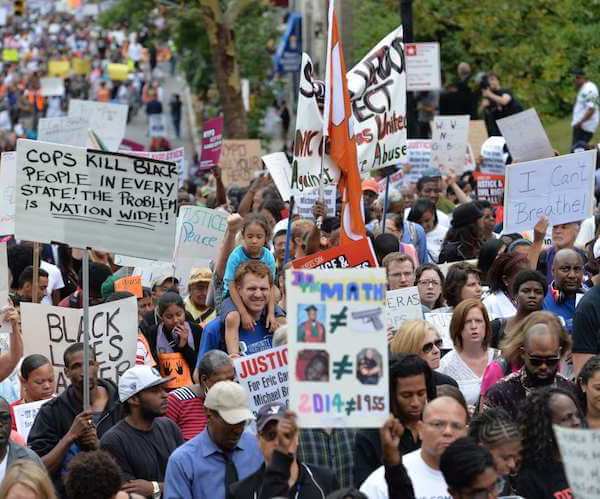
WASHINGTON — Activists involved with the Ferguson, Missouri, protests followed their presidential meeting on Monday with words of caution: There’s a long fight ahead to make crucial changes to police practices in the St. Louis region and across the country.
Several of those who met with President Barack Obama said they were generally encouraged, and they framed the White House meeting as an indication that their movement is having an impact. They said they saw some progress in the moderate initiatives on police training and push for police body cameras announced by the White House on Monday, though they agreed there was a lot more to be done. A list of goals released by multiple activists demands that the federal government, among other actions, get more aggressive in prosecuting police officers who kill people and stop sending money to local police departments that use excessive force or engage in racial profiling.
“We’re definitely going to keep doing the work on the ground, but meeting with the president, for me — well, I’ll say for everybody — is just an affirmation that this movement is working,” said Ashley Yates, co-founder of the group Millennial Activists United, in a conference call with reporters on Tuesday. Yates, who goes by@BrownBlaze on Twitter, posted a selfie with Vice President Joe Biden following the meeting.
Phillip Agnew, of the group Dream Defenders, said on the call, “This moment has awakened the consciousness of folks around the country, and what we’ve seen — as much coordination as folks in Ferguson, folks around Ferguson, folks on this line have done to ensure that there’s infrastructure for this movement — there are people around the country that are waking up and acting on their own.”
“And that’s a hallmark of this movement: It is decentralized,” he said.
Leaders of more established civil rights organizations struck a similar tone, declaring that the changes that will grow out of the protests following the death of Michael Brown have just begun.
Sherrilyn Ifill, president of the NAACP Legal Defense and Educational Fund, said in a statement Tuesday that the White House meeting was “a significant first step in acknowledging the problem of racial bias in policing and searching for real, concrete measures for change.”
Read full article here.
Read more Breaking News here.
Comments Are Welcome
Note: We moderate submissions in order to create a space for meaningful dialogue, a space where museum visitors – adults and youth –– can exchange informed, thoughtful, and relevant comments that add value to our exhibits.
Racial slurs, personal attacks, obscenity, profanity, and SHOUTING do not meet the above standard. Such comments are posted in the exhibit Hateful Speech. Commercial promotions, impersonations, and incoherent comments likewise fail to meet our goals, so will not be posted. Submissions longer than 120 words will be shortened.
See our full Comments Policy here.