‘Why Don’t We Have Any White Kids?’
Share
Explore Our Galleries









Breaking News!
Today's news and culture by Black and other reporters in the Black and mainstream media.
Ways to Support ABHM?
By N.R. KLEINFIELD, New York Times
IN seventh-grade English class, sun leaked in through the windows. Horns bleated outside. The assignment was for the arrayed students to identify a turning point in their lives. Was it positive or negative? They hunched over and wrote fervidly.
Floriande Augustin, a first-year teacher at the school, invited students to share their choices. Hands waved for attention. One girl said it was when she got a cat, though she was unsure why. Another selected a car crash. A third brought up the time when her cousin got shot and “it was positive because he felt his life was crazy and he went to college so he couldn’t get shot anymore.”
The lesson detoured into Martin Luther King Jr. and his turning points. Ms. Augustin listed things like how his father took him shopping for shoes and they were made to wait in the back. How a bus driver told him to relinquish his seat to a white passenger and stand in the rear. How he wasn’t allowed to play with his white friends once he started school, because he went to a black school and his white friends went to a white school.
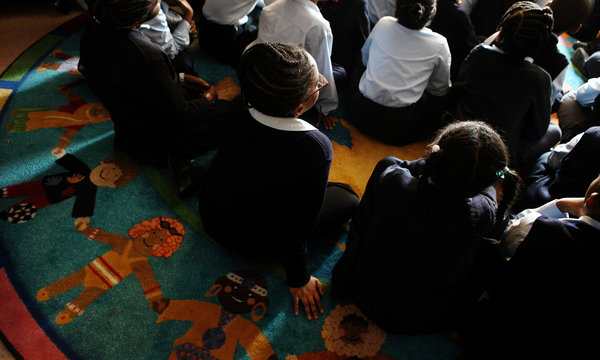
The students scribbled notes. Unmentioned was a ticklish incongruity that hung glaringly obvious in the air. This classroom at Explore Charter School in Flatbush, Brooklyn, was full of black students in a school almost entirely full of black students. As Ms. Augustin, who is also black, later reflected, “There was something about, ‘Huh, here we are talking about that and look at us — we’re all the same.’ ”
In the broad resegregation of the nation’s schools that has transpired over recent decades, New York’s public-school system looms as one of the most segregated. While the city’s public-school population looks diverse — 40.3 percent Hispanic, 32 percent black, 14.9 percent white and 13.7 percent Asian — many of its schools are nothing of the sort.
About 650 of the nearly 1,700 schools in the system have populations that are 70 percent a single race, a New York Times analysis of schools data for the 2009-10 school year found; more than half the city’s schools are at least 90 percent black and Hispanic. Explore Charter is one of them: of the school’s 502 students from kindergarten through eighth grade this school year, 92.7 percent are black, 5.7 percent are Hispanic, and a scattering are of mixed race. None are white or Asian. There is a good deal of cultural diversity, with students, for instance, of Haitian, Guyanese and Nigerian heritage. But not of class. Nearly 80 percent of the students qualify for subsidized lunch, a mark of poverty. The school’s makeup is in line with charter schools nationally, which are over all less integrated than traditional public schools.
At Explore, as at many schools in New York City, children trundle from segregated neighborhoods to segregated schools, living a hermetic reality.
Read more of the story here.
Learn about the case that should have ended education segregation.
Our breaking news archive covers more stories about the Black experience.
Comments Are Welcome
Note: We moderate submissions in order to create a space for meaningful dialogue, a space where museum visitors – adults and youth –– can exchange informed, thoughtful, and relevant comments that add value to our exhibits.
Racial slurs, personal attacks, obscenity, profanity, and SHOUTING do not meet the above standard. Such comments are posted in the exhibit Hateful Speech. Commercial promotions, impersonations, and incoherent comments likewise fail to meet our goals, so will not be posted. Submissions longer than 120 words will be shortened.
See our full Comments Policy here.