10 Years Later: How #SayHerName Transformed Advocacy For Black Women And Girls
Share
Explore Our Galleries









Breaking News!
Today's news and culture by Black and other reporters in the Black and mainstream media.
Ways to Support ABHM?
By Shannon Dawson, NewsOne
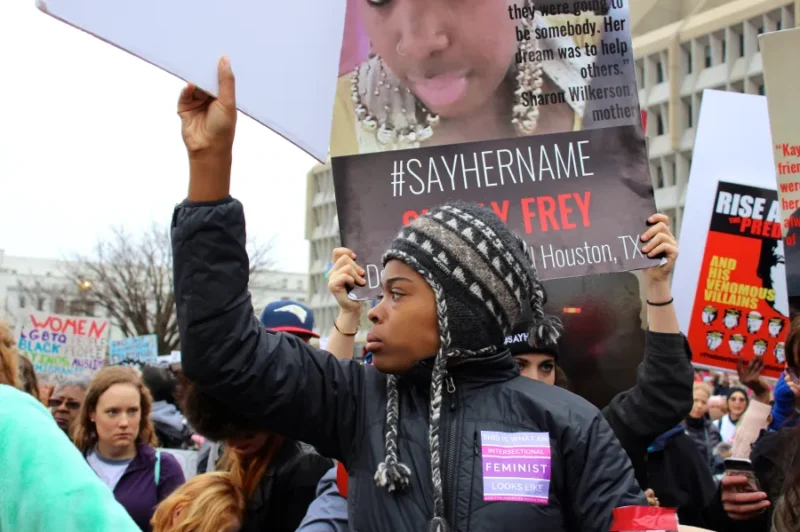
In recent years, the phrase #SayHerName has become a powerful global rallying cry and social media hashtag in the fight for racial justice, bringing attention to the often overlooked stories of Black women who suffer from police violence and systemic oppression. While the phrase is now widely recognized, its roots lie in a long history of grief and pain.
As we mark the 10th anniversary of this vital movement, it’s important to reflect on the journey that brought us to this point.
The Birth of the “#SayHerName.”
Coined by civil rights activist and African American Policy Forum (AAPF) founder Kimberlé Crenshaw in 2014, #SayHerName was born out of the urgent need to center the experiences of Black women victimized by police brutality and violence. While the Black Lives Matter movement had been widely recognized for drawing attention to the murders of Black men like Trayvon Martin, Michael Brown, and Eric Garner, the stories of Black women were often overshadowed.
In 2014, an alarming number of Black women died at the hands of law enforcement, including Tanisha Anderson, a 37-year-old mother who passed away after she was slammed on the pavement outside of her home as Cleveland police were apprehending her. Aura Rosser was another painful story that went underreported. The 40-year-old Black woman was tased and then killed by a police officer who entered her home in Ann Arbor, Michigan. Rosser and Anderson’s exclusion from media reports was especially painful for families and activists who understood that Black women, too, were disproportionately affected by state-sanctioned violence, impacting Black women and girls as young as 7 and as old as 93. Crenshaw knew she had to do something to address the glaring issue.
[…]
The #SayHerName campaign emerged as a powerful response to the growing need to highlight the experiences of Black women who have been victims of police brutality and state-sanctioned violence. Gaining national prominence in 2015, the movement was catalyzed by the tragic death of Sandra Bland, a 28-year-old Black woman found dead in her jail cell in Texas several days after being arrested, following a routine traffic stop. Bland’s death, ruled a suicide by hanging, prompted widespread outrage, particularly as it exposed the systemic issues surrounding the treatment of Black women by law enforcement. For many, Bland’s case symbolized how Black women’s experiences were often ignored in broader discussions about police violence.
Crenshaw understands critical race theory–and how others misunderstand it.
Comments Are Welcome
Note: We moderate submissions in order to create a space for meaningful dialogue, a space where museum visitors – adults and youth –– can exchange informed, thoughtful, and relevant comments that add value to our exhibits.
Racial slurs, personal attacks, obscenity, profanity, and SHOUTING do not meet the above standard. Such comments are posted in the exhibit Hateful Speech. Commercial promotions, impersonations, and incoherent comments likewise fail to meet our goals, so will not be posted. Submissions longer than 120 words will be shortened.
See our full Comments Policy here.