Who Were the Great Black Historians?
Share
Explore Our Galleries









Breaking News!
Today's news and culture by Black and other reporters in the Black and mainstream media.
Ways to Support ABHM?
Henry Louis Gates, Jr., The Root
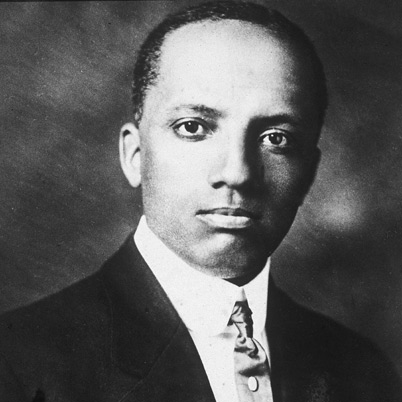
Amazing Fact About the Negro No. 99: Who were the key scholars responsible for the discipline of black history?
The 500-year story of the African-American people, as we tried to show in our PBS documentary series Many Rivers to Cross, is inseparable from that of America as a whole. Not that long ago, lest we forget, the prevailing opinion in this country was that black people had no history—at least not one worth writing about or teaching. To refute that charge, it took generations of pioneering historians to recover the pieces of our buried and scattered past and to mend them into narratives as amazing as any the world has known. What to some was a joke—a futile effort in frivolity—was to these scholars a life’s calling. And in pursuing the black historical past so brilliantly and passionately, they succeeded in placing the American historical profession on much higher ground, and inspiring African Americans—and, over time, the country as a whole—to demand that the promise of citizenship and civil rights be fulfilled for a people who had waited for both so very long—too long, in fact.
As I prepare to conclude The Root’s 100 Amazing Facts About the Negro series with my 100th column next week—a retrospective on our old friend Joel A. Rogers—I’d like to honor a few of the great black historians whose diligent work and careful scholarship made it impossible for anyone to deny that African-American history was, and has always been, a fundamental part of American history.
Two of those historians you’ve met in earlier columns: Carter G. Woodson, “the father of Black History Month,” and George Washington Williams, “black America’s first investigative journalist.” The great W.E.B. Du Bois—the first black person in the world to earn a Ph.D. in history—has hovered over this entire series—as he does over African-American history as a whole. Permit me then to introduce you to five more academically trained black historians, with doctorates from accredited institutions you should know, whose books you should read and upon whose shoulders all scholars of African-American studies stand: Rayford W. Logan, Charles H. Wesley, Dorothy Porter Wesley, John Hope Franklin and John W. Blassingame Sr.
If ever a Mount Rushmore for black historians were to be carved on the face of a mountain, you can bet the eight faces I just mentioned would be on it.
Read full article here.
Read more Breaking News here.
Comments Are Welcome
Note: We moderate submissions in order to create a space for meaningful dialogue, a space where museum visitors – adults and youth –– can exchange informed, thoughtful, and relevant comments that add value to our exhibits.
Racial slurs, personal attacks, obscenity, profanity, and SHOUTING do not meet the above standard. Such comments are posted in the exhibit Hateful Speech. Commercial promotions, impersonations, and incoherent comments likewise fail to meet our goals, so will not be posted. Submissions longer than 120 words will be shortened.
See our full Comments Policy here.
Thank you for all you’ve done/are doing to share the true and complete history of AmeriKa