U.S. museums return African bronzes stolen in 19th century
Share
Explore Our Galleries









Breaking News!
Today's news and culture by Black and other reporters in the Black and mainstream media.
Ways to Support ABHM?
By Associated Press and Claretta Bellamy, NBC News
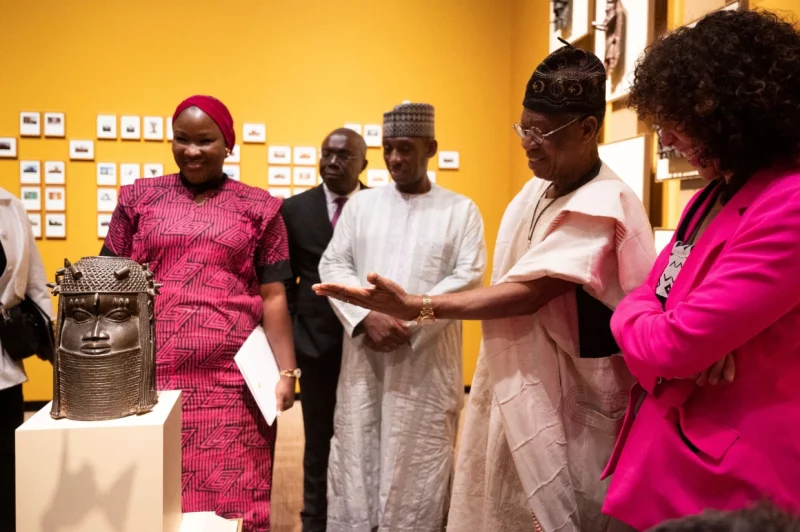
A bronze sculpture of a West African king that had been in the collection of a Rhode Island museum for more than 70 years was among 31 culturally precious objects that were returned to the Nigerian government on Tuesday.
The Benin Bronzes, including a piece called the “Head of a King” or “Oba” from the Rhode Island School of Design Museum, were transferred to the Nigerian National Collections during a ceremony at the Smithsonian Institution in Washington, D.C. The pieces that were stolen by the British in the late 19th century included 29 that the Smithsonian Institution’s Board of Regents voted in June to return, and one object from the National Gallery of Art, officials said.
The RISD Museum’s piece, believed to date to the 1700s, was a gift from Lucy Truman Aldrich in 1939. It had been acquired in a 1935 sale of objects from the Benin Kingdom from the Knoedler Gallery in New York, the museum said in a statement.
The repatriation is part of a worldwide movement by cultural institutions to return artifacts that were often stolen during colonial wars. African nations and scholars have put pressure on the United Nations Educational, Scientific and Cultural Organization, or UNESCO, to return stolen African artifacts for years, according to Chika Okeke-Agulu, program director of African studies at Princeton University. But he said most African artifacts tend to remain in Europe. French art historians estimate that 90% of Africa’s cultural heritage is believed to be in Europe. However, Okeke-Agulu said there is a push by leaders to change those numbers.
One major factor is “pressure from African … voices that have in the past decade or so consistently kept the pressure on these institutions to give up these objects that were expropriated from Benin City,” he said. “The other aspect has to do with the changing attitudes of these institutions, sometimes internally generated, as is the case with many university museums where students are the ones often putting pressure on their institutions to change their behavior and attitude and disposition to our looted objects, especially colonially.”
African artifacts and people were both forcibly removed from Africa.
Don’t leave before checking out ABHM’s breaking news.
Comments Are Welcome
Note: We moderate submissions in order to create a space for meaningful dialogue, a space where museum visitors – adults and youth –– can exchange informed, thoughtful, and relevant comments that add value to our exhibits.
Racial slurs, personal attacks, obscenity, profanity, and SHOUTING do not meet the above standard. Such comments are posted in the exhibit Hateful Speech. Commercial promotions, impersonations, and incoherent comments likewise fail to meet our goals, so will not be posted. Submissions longer than 120 words will be shortened.
See our full Comments Policy here.