To help fight racial inequality among our children, look at nutrition in school
Share
Explore Our Galleries









Breaking News!
Today's news and culture by Black and other reporters in the Black and mainstream media.
Ways to Support ABHM?
By. Dr. Robert S. Harvey, theGrio
OPINION: Research shows that access to school meals can actually lead to better grades in math and reading and that hungry stomachs are a distraction from learning.
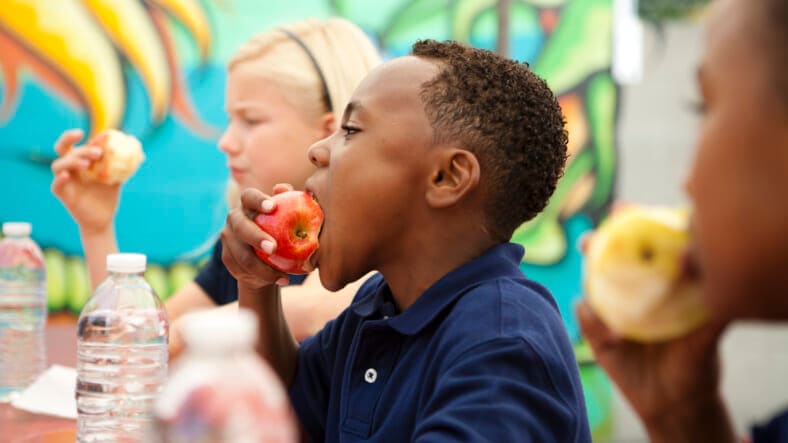
It is no secret that decision-makers fight an uphill battle to ensure an equal starting point for every child who enters an American classroom. Less widely known is that the socioeconomic inequities they’re fighting actually carry over into our school cafeterias and to kids’ school breakfast and lunch trays.
This September, the White House will hold a Conference on Hunger, Nutrition, and Health—the first of its kind in 50 years—with a key focus on the disproportionate impact that underserved and marginalized communities face when it comes to nutrition. A conversation about real equity—and subsequent policy and action—cannot happen without the topic of food in schools.
Over time, Americans of all races, religions and political affiliations have come to believe that a high-quality education remains an ongoing imperative for every child in every community to transcend inequity and poverty of opportunity—shadows of the American dream. That includes access to—and education about—the food our students eat.
The concept of food as a driver for equity is nothing new. During his 1964 Nobel Peace Prize acceptance speech, the Rev. Martin Luther King Jr. opined: “I have the audacity to believe that peoples everywhere can have three meals a day for their bodies, education and culture for their minds, and dignity, equality, and freedom for their spirits.” In January 1969, when the Black Panther Party served its first free breakfast at St. Augustine’s Church in Oakland, Calif., a member of the party posed the question, “How can a person be expected to pay attention and learn about history, math, science, and other subjects that are abstract to reality when [their] mind is concentrating on a very real and concrete problem? Where is the next meal coming from?”
Dr. Harvey paints nutrition as a crucial bipartisan issue.
This health disparity can start in infancy when Black mothers cannot breastfeed.
Our breaking news page has more articles like this.
Comments Are Welcome
Note: We moderate submissions in order to create a space for meaningful dialogue, a space where museum visitors – adults and youth –– can exchange informed, thoughtful, and relevant comments that add value to our exhibits.
Racial slurs, personal attacks, obscenity, profanity, and SHOUTING do not meet the above standard. Such comments are posted in the exhibit Hateful Speech. Commercial promotions, impersonations, and incoherent comments likewise fail to meet our goals, so will not be posted. Submissions longer than 120 words will be shortened.
See our full Comments Policy here.