The Quiet Crisis Killing Black Women
Share
Explore Our Galleries









Breaking News!
Today's news and culture by Black and other reporters in the Black and mainstream media.
Ways to Support ABHM?
By Melissa Jeltsen, The Huffington Post
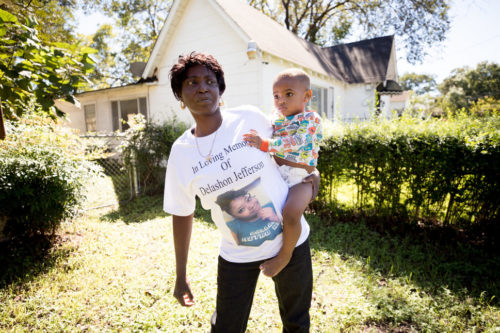
Sharon Jefferson, 43, holds her grandson Ray Ray Rainey ,2. Her daughter , Delashon Jefferson, was murdered by her boyfriend in September. The baby that her daughter was pregnant with is in ICU at Baylor Hospital in Dallas, Texas.
DALLAS ― Before she died, Delashon Jefferson tacked a certificate to her bedroom wall.
The piece of paper, edged in gold like a diploma, was proof that her boyfriend had completed an anger management program. For Delashon, 20, it was more than that. It was a promise that her boyfriend was getting better…
Earlier this fall, police say, Rainey shot Delashon inside her bedroom when she was eight months pregnant. She was killed in front of her son…
In death, Delashon became one of the three women killed by their boyfriends, husbands and lovers every day in the United States. Domestic violence does not discriminate, and victims span all races, ages, ethnicities and religions.
The suffering, though, is not equally distributed.
In the U.S., black women face higher rates of domestic violence than do women of all other races, except Native women. In Dallas County, the most likely type of person to be killed by a romantic partner is a black woman, age 20 to 29, just like Delashon. Black women are four times more likely than their white peers to be murdered by a boyfriend or girlfriend, and twice as likely to be killed by a spouse. And they are seven times more likely to be slain while pregnant than white women.
Experts say this is not because black men are more violent. Rather, black women are more vulnerable to domestic violence due to a constellation of factors, including high rates of poverty, lack of access to resources and systemic racism within systems designed to help victims of abuse.
Since the passage of the Violence Against Women Act in 1994, the central response to domestic violence in the U.S. has been criminal. Victims are told to call the cops, press charges and help prosecutors put their abusers behind bars.
But relying on police can leave black women facing an impossible quandary: How can they trust a historically racist criminal justice system, one that systematically imprisoned their brothers and fathers, to protect them?
Read the full article here
Read more Breaking News here
View more galleries from the ABHM here
Comments Are Welcome
Note: We moderate submissions in order to create a space for meaningful dialogue, a space where museum visitors – adults and youth –– can exchange informed, thoughtful, and relevant comments that add value to our exhibits.
Racial slurs, personal attacks, obscenity, profanity, and SHOUTING do not meet the above standard. Such comments are posted in the exhibit Hateful Speech. Commercial promotions, impersonations, and incoherent comments likewise fail to meet our goals, so will not be posted. Submissions longer than 120 words will be shortened.
See our full Comments Policy here.