The Lesser-Known History of African-American Cowboys
Share
Explore Our Galleries









Breaking News!
Today's news and culture by Black and other reporters in the Black and mainstream media.
Ways to Support ABHM?
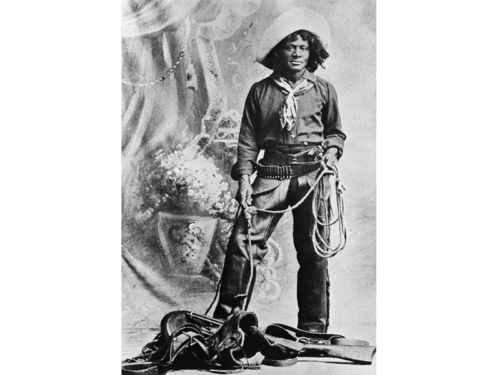
This image appeared in cowboy Nat Love’s privately published autobiography. (Corbis)
By Katie Nodjimbadem
In his 1907 autobiography, cowboy Nat Love recounts stories from his life on the frontier so cliché, they read like scenes from a John Wayne film. He describes Dodge City, Kansas, a town smattered with the romanticized institutions of the frontier: “a great many saloons, dance halls, and gambling houses, and very little of anything else.” He moved massive herds of cattle from one grazing area to another, drank with Billy the Kid and participated in shootouts with Native peoples defending their land on the trails. And when not, as he put it, “engaged in fighting Indians,” he amused himself with activities like “dare-devil riding, shooting, roping and such sports.”
Related Content
Though Love’s tales from the frontier seem typical for a 19th-century cowboy, they come from a source rarely associated with the Wild West. Love was African-American, born into slavery near Nashville, Tennessee.
Few images embody the spirit of the American West as well as the trailblazing, sharpshooting, horseback-riding cowboy of American lore. And though African-American cowboys don’t play a part in the popular narrative, historians estimate that one in four cowboys were black…
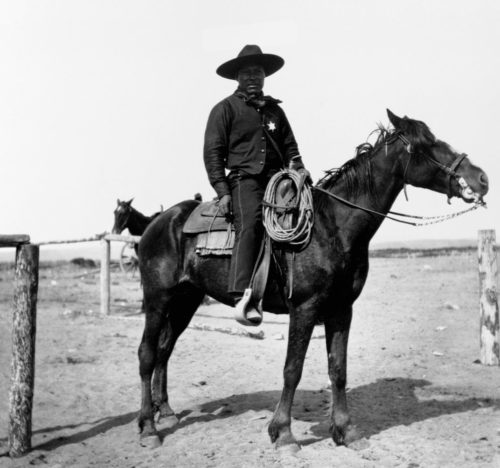
An African-American cowboy sits saddled on his horse in Pocatello, Idaho in 1903. (Corbis)
White Americans seeking cheap land—and sometimes evading debt in the United States—began moving to the Spanish (and, later, Mexican) territory of Texas during the first half of the 19th century. Though the Mexican government opposed slavery, Americans brought slaves with them as they settled the frontier and established cotton farms and cattle ranches. By 1825, slaves accounted for nearly 25 percent of the Texas settler population…
Read full article here
Read more Breaking News here
View more ABHM galleries here
Comments Are Welcome
Note: We moderate submissions in order to create a space for meaningful dialogue, a space where museum visitors – adults and youth –– can exchange informed, thoughtful, and relevant comments that add value to our exhibits.
Racial slurs, personal attacks, obscenity, profanity, and SHOUTING do not meet the above standard. Such comments are posted in the exhibit Hateful Speech. Commercial promotions, impersonations, and incoherent comments likewise fail to meet our goals, so will not be posted. Submissions longer than 120 words will be shortened.
See our full Comments Policy here.