The Incredible Story of Edmonia Lewis, America’s First Black and Indigenous International Art Star
Share
Explore Our Galleries









Breaking News!
Today's news and culture by Black and other reporters in the Black and mainstream media.
Ways to Support ABHM?
Sarah Cascone, Artnet
Tourists flocked Lewis’s studio, but she died in obscurity. Now, she’s back in the spotlight
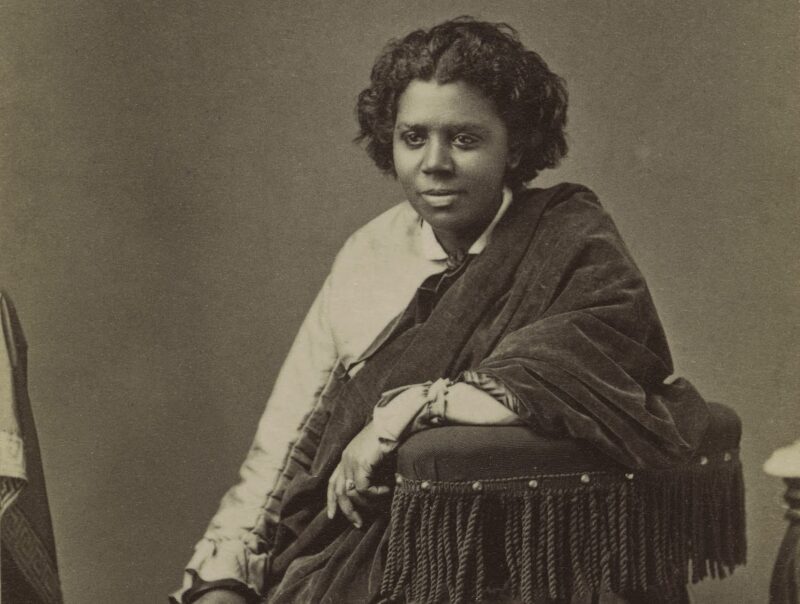
Edmonia Lewis is perhaps one of art history’s most unlikely success stories. The first Black and Indigenous artist born in the U.S. to chart a path to international acclaim as a sculptor, she created classically inspired works that championed the social causes of the day, including emancipation and Indigenous sovereignty. But she died in obscurity in 1907, buried in an unmarked grave in London.
Now, over a century after her death, Lewis’s remarkable career is the subject of her first-ever retrospective, thanks to “Edmonia Lewis: Said in Stone,” currently on view at the Peabody Essex Museum in Salem, Massachusetts. It is curated by Shawnya L. Harris, the curator of African American and African diasporic art at the Georgia Museum of Art—where the show will open in August—and Jeffrey Richmond-Moll, an American art curator formerly of the Georgia Museum, now at the PEM.
The remarkable traveling exhibition is the result of seven years of planning, in part due to the logistical and financial challenges of showing large-scale works in marble, Lewis’s favored medium. Many of her 70-to-80 known sculptures have also been lost over the decades, which meant some serious detective work to track down the 30 pieces on view.
“We wanted to provide as comprehensive a view of her career as possible,” Richmond-Moll said. “There was no cache of papers. It was a matter of sifting through, looking for fragments of correspondence and press interviews, and following those trails to find her work.”
Keep reading to discover who Lewis was.
Discover more art by and about the Black community in our Special Exhibits gallery.
Comments Are Welcome
Note: We moderate submissions in order to create a space for meaningful dialogue, a space where museum visitors – adults and youth –– can exchange informed, thoughtful, and relevant comments that add value to our exhibits.
Racial slurs, personal attacks, obscenity, profanity, and SHOUTING do not meet the above standard. Such comments are posted in the exhibit Hateful Speech. Commercial promotions, impersonations, and incoherent comments likewise fail to meet our goals, so will not be posted. Submissions longer than 120 words will be shortened.
See our full Comments Policy here.