The enslaved man who popularised mac and cheese
Share
Explore Our Galleries









Breaking News!
Today's news and culture by Black and other reporters in the Black and mainstream media.
Ways to Support ABHM?
By Lynn Brown, BBC
The baked dish is one of the US’s most popular foods, but its rise can likely be traced back to an enslaved Black chef who worked for Thomas Jefferson.
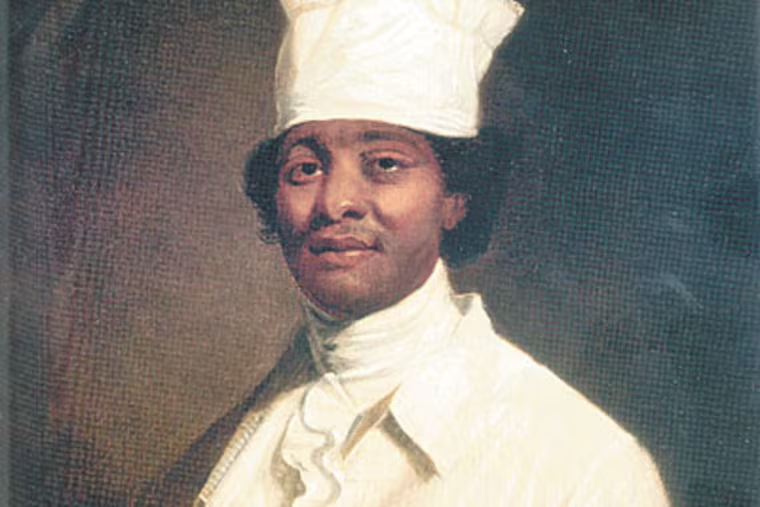
This year, as millions of families in the US sit down to celebrate Thanksgiving, many will tuck into one of the most quintessentially “American” foods: macaroni and cheese. But while some sources trace the baked dish’s mysterious origins to Italy or Switzerland, the dish as Americans know it today may have been popularised in the New World via an unlikely figure – an enslaved chef named James Hemings.
In 1784, long before he became president, Thomas Jefferson was appointed US minister to France and brought Hemings with him. Jefferson wanted the young man to be trained as a chef so he could preside over the kitchen at Monticello, his plantation estate in Virginia.
[…]
In Paris, Hemings trained as both a chef de cuisine and pastry chef. “[Hemings was] not only one of the first French-trained chefs from the United States, but certainly one of the first Black French-trained chefs,” Brown said.
After five years in Paris, Hemings brought his new skills back to the US and served as Jefferson’s head chef at Monticello, as well as in New York and Philadelphia, until he was able to negotiate his own freedom in 1796. Using French techniques such as braising, poaching and sautéing, he created delicate dishes that would have been almost unheard of in 18th-Century America, including the “snow egg”, a poached meringue served floating in crème anglaise. Since pasta baked with cheese had become a popular dish in France by the time Hemings trained there, he likely learned this there and brought it back to the US as well.
As Hemings served these French-inspired dishes to dignitaries, American socialites and many of the era’s top tastemakers up and down the east coast, many of his dishes and cooking methods became de rigueur in households across the newly formed nation. According to Brown, most American foods of the time would have been cooked over a hearth or in an open fireplace. Hemings’ dishes however, required more advanced methods and a stew stove, the precursor to the modern stove, which would have allowed for greater control over the heat. As the well-to-do guests who dined with Jefferson wanted to emulate Hemings’ cooking style, the enslaved chef began to heavily influence the US’s culinary culture.
[…]
The baked dish then called “macaroni pie“, was a particular favourite of Jefferson’s and was frequently served at his table. Hemings’ version was created by cooking the macaroni in a mixture of milk and water, and then layering cheese and butter with the cooked pasta before baking.
Discover Hemings’ complicated relationship with Jefferson and how his culinary skills influenced how we eat today.
Some are angry about having to learn the reality of slavery at Monticello, including that Jefferson fathered children with Hemings’ sister, Sally.
Comments Are Welcome
Note: We moderate submissions in order to create a space for meaningful dialogue, a space where museum visitors – adults and youth –– can exchange informed, thoughtful, and relevant comments that add value to our exhibits.
Racial slurs, personal attacks, obscenity, profanity, and SHOUTING do not meet the above standard. Such comments are posted in the exhibit Hateful Speech. Commercial promotions, impersonations, and incoherent comments likewise fail to meet our goals, so will not be posted. Submissions longer than 120 words will be shortened.
See our full Comments Policy here.