The Civil Rights Movement Changed America. We Glorify It at Our Peril.
Share
Explore Our Galleries









Breaking News!
Today's news and culture by Black and other reporters in the Black and mainstream media.
Ways to Support ABHM?
Matthew F. Delmont, The New York Times
Rejecting prevailing views of the movement as either exemplary or ineffectual, Brandon M. Terry offers a bold new vision of our history.
In February 1959, the Rev. Dr. Martin Luther King Jr., Coretta Scott King and Martin’s friend and colleague Lawrence Reddick took a six-week trip to India that included stops in London, Paris, Beirut, Jerusalem and Cairo. The journey deepened King’s understanding of Gandhian principles of nonviolence and the global scope of the struggle for justice and human dignity in the face of racism and imperialism.
Upon his return to Dexter Avenue Baptist Church, in Montgomery, Ala., King, just weeks past his 30th birthday, delivered a sermon calling on his parishioners to reckon honestly with all the ways the world might thwart their ambitions. “Who here this morning,” he asked, “has not had to face the agony of blasted hopes and shattered dreams?”
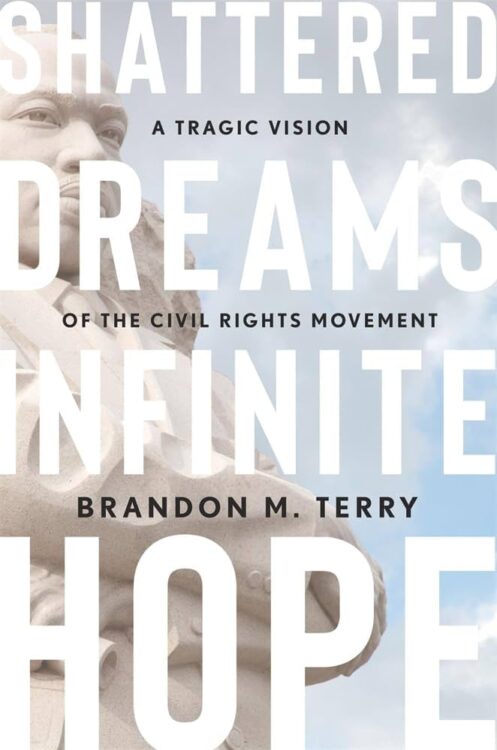
Taking its title from this sermon, Brandon M. Terry’s searching, timely and provocative new book, “Shattered Dreams, Infinite Hope,” is an extended meditation on what King called “the tragic element in life.” Terry, a professor of social sciences at Harvard, examines how competing histories of the civil rights movement have shaped Americans’ understanding of civic ideals, political commitments, moral principles and social policies.
“Our era,” he writes, “is decades into the building of both a grand edifice of civil rights memorialization with universalist aspirations and a stubborn regime of post-Jim Crow racial inequality whose burdens fall far more narrowly.” Terry aims to guide readers through a disorienting landscape where the legacy of the civil rights movement is, at different times and for different political purposes, celebrated, attacked, ignored and undermined.
He begins by considering what it means for the civil rights movement to be enshrined in history as “exemplary.” The movement is not merely a set of iconic figures and events, Terry suggests; it is also the primary example used to make sense of abstract concepts like citizenship, democracy, freedom and civil disobedience. “By rethinking our interpretive practices we can make visible the often overlooked connective tissue binding political philosophy, political rhetoric, historical imagination and narrative,” he writes.
Continue reading to learn why it’s so urgent for us to understand this.
Our virtual exhibits about the Civil Rights Movement aim for nuance.
Comments Are Welcome
Note: We moderate submissions in order to create a space for meaningful dialogue, a space where museum visitors – adults and youth –– can exchange informed, thoughtful, and relevant comments that add value to our exhibits.
Racial slurs, personal attacks, obscenity, profanity, and SHOUTING do not meet the above standard. Such comments are posted in the exhibit Hateful Speech. Commercial promotions, impersonations, and incoherent comments likewise fail to meet our goals, so will not be posted. Submissions longer than 120 words will be shortened.
See our full Comments Policy here.