The Boston Tea Party Turns 250
Share
Explore Our Galleries









Breaking News!
Today's news and culture by Black and other reporters in the Black and mainstream media.
Ways to Support ABHM?
Jennifer Schuessler, The New York Times
How does the most famous act of politically motivated property destruction in American history speak to our own polarized moment?
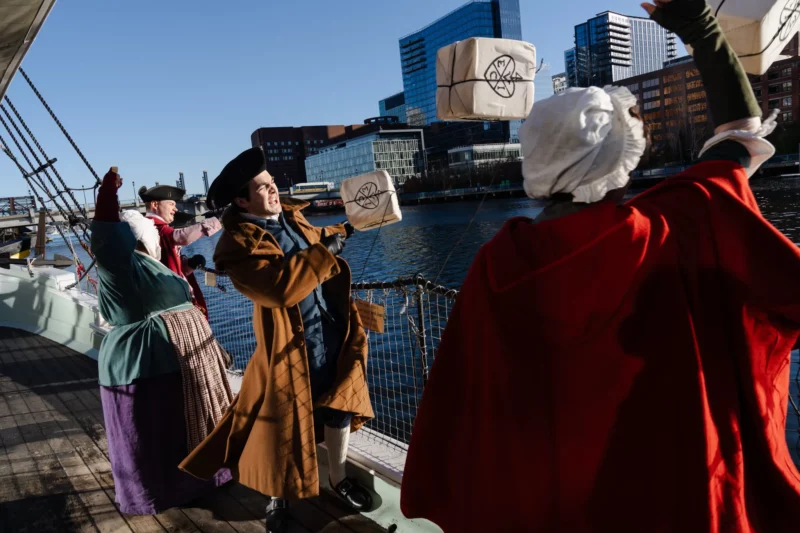
On Saturday, just as they do every day, a group of costumed people will storm aboard three replicas of 18th-century wooden ships docked in Boston and enthusiastically throw a bunch of tea into the harbor.
But this time, those who gather at the Boston Tea Party Ships and Museum to re-enact the most famous riot in American history will not be everyday tourists. And they will have plenty of reinforcements.
Before the dumping, hundreds of Bostonians will gather at the Old South Meeting House to restage the raucous gathering on Dec. 16, 1773, of citizens outraged by what they saw as illegitimate taxes and other oppressive measures imposed by the British. Outside, they will be joined by thousands for a fife-and-drum-fired “rolling rally” to the wharf, where costumed re-enactors will dump nearly 2,000 pounds of tea donated from all over the world.
The 250th anniversary of the Boston Tea Party is the first major beat in the run-up to the celebration of America’s Semiquincentennial in 2026. For Boston, it is a chance to spiff up its monuments and bring plenty of visitors to town.
But for some planners, the anniversary is also a moment to pose some challenging questions. How do we celebrate the fight for liberty in a period when many Americans, including in Boston, were enslaved? And how do we really feel about protest, violence and revolution today?
Those questions are especially fraught at a time when even the date “1776” itself has become a divisive symbol, said Nathaniel Sheidley, the president and chief executive of Revolutionary Spaces, which operates the Old South Meeting House and the Old State House.
“The commemoration is an opportunity,” he said, “to articulate that the American Revolution wasn’t one struggle, but many.”
Read more in the original article.
Explore the meaning of the revolution for ex-slave and abolitionist Frederick Douglass in this virtual exhibit.
Find more Breaking News here.
Comments Are Welcome
Note: We moderate submissions in order to create a space for meaningful dialogue, a space where museum visitors – adults and youth –– can exchange informed, thoughtful, and relevant comments that add value to our exhibits.
Racial slurs, personal attacks, obscenity, profanity, and SHOUTING do not meet the above standard. Such comments are posted in the exhibit Hateful Speech. Commercial promotions, impersonations, and incoherent comments likewise fail to meet our goals, so will not be posted. Submissions longer than 120 words will be shortened.
See our full Comments Policy here.