The Black press democratized America
Share
Explore Our Galleries









Breaking News!
Today's news and culture by Black and other reporters in the Black and mainstream media.
Ways to Support ABHM?
By Nicole Carr, The Emancipator
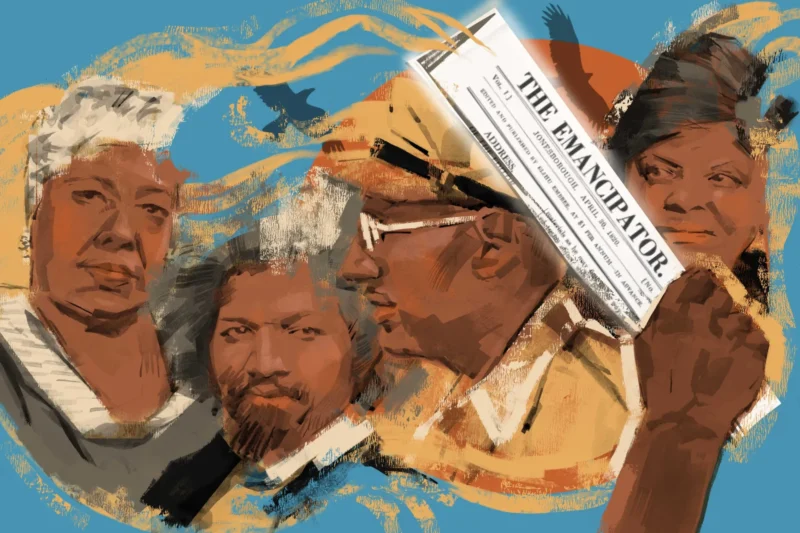
Ahead of Trump’s second term, the historic Black press can serve as a guiding light for practicing journalism in pursuit of a healthy democracy — or, at least, survival and community.
[…]
Prior to Election Day, they’d imagined this through their long-distance course with their Howard University professor Nikole Hannah-Jones. The New York Times journalist and 1619 Project creator encouraged them to explore the significance behind major news organizations’ decision to forgo a presidential endorsement. The unprecedented move rejected decades-old tradition of the press acting as a check on government by distilling for readers which political choice might best serve the electorate. Facts gleaned from newsroom coverage helped shape these endorsements. The decision unfolded in an era in which many of the nation’s largest publications are now owned by those with business interests dependent on the outcome of the race.
[…]
President-elect Trump has and will continue to target the news media with vitriol, declaring journalists as enemies of the people that his following should despise. It is imperative that we study how the historic Black press has muscled through similar times when power sought to reshape reality through mainstream media, launch hateful attacks against racial and ethnic minorities to block their access to the ballot, and foment violence through their words and actions to destabilize communities.
The historic Black press can serve as a guiding light for practicing journalism in pursuit of a healthy democracy — or, at least, survival and community. They most often achieved this by opting against adopting a false neutrality and poor framing, opting instead to tell the truth in the plainest terms.
The Freedom’s Journal, which in 1827 became the nation’s first Black newspaper, famously declared that “too long have others spoken for us.” That meant even well-intentioned abolitionists had to step aside and allow those closest to the injustice help lead the narrative.
Check out this exhibit to learn more about the Crucial Role of the Black Press.
More Breaking News here.
Comments Are Welcome
Note: We moderate submissions in order to create a space for meaningful dialogue, a space where museum visitors – adults and youth –– can exchange informed, thoughtful, and relevant comments that add value to our exhibits.
Racial slurs, personal attacks, obscenity, profanity, and SHOUTING do not meet the above standard. Such comments are posted in the exhibit Hateful Speech. Commercial promotions, impersonations, and incoherent comments likewise fail to meet our goals, so will not be posted. Submissions longer than 120 words will be shortened.
See our full Comments Policy here.