Special News Series: Rising Up For Justice! – Whose Heritage? Public Symbols of the Confederacy
Share
Explore Our Galleries









Breaking News!
Today's news and culture by Black and other reporters in the Black and mainstream media.
Ways to Support ABHM?
Introduction To This Series:
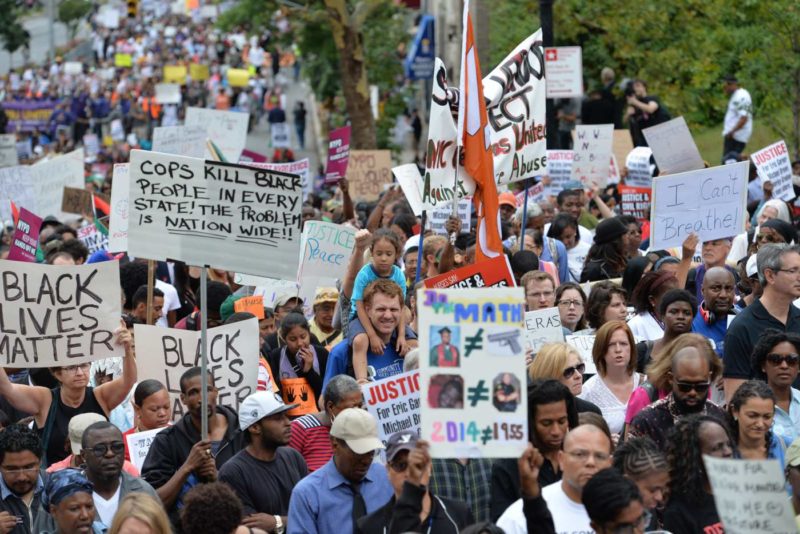
This post is one installment in an ongoing news series: a “living history” of the current national and international uprising for justice.
Today’s movement descends directly from the many earlier civil rights struggles against repeated injustices and race-based violence, including the killing of unarmed Black people. The posts in this series serve as a timeline of the uprising that began on May 26, 2020, the day after a Minneapolis police officer killed an unarmed Black man, George Floyd, by kneeling on his neck. The viral video of Floyd’s torturous suffocation brought unprecedented national awareness to the ongoing demand to truly make Black Lives Matter in this country.
The posts in this series focus on stories of the particular killings that have spurred the current uprising and on the protests taking place around the USA and across the globe. Sadly, thousands of people have lost their lives to systemic racial, gender, sexuality, judicial, and economic injustice. The few whose names are listed here represent the countless others lost before and since. Likewise, we can report but a few of the countless demonstrations for justice now taking place in our major cities, small towns, and suburbs.
To view the entire series of Rising Up for Justice! posts, insert “rising up” in the search bar above.
Whose Heritage? Public Symbols of the Confederacy
Our public entities should no longer play a role in distorting history by honoring a secessionist government that waged war against the United States to preserve white supremacy and the enslavement of millions of people. It’s past time for the South – and the rest of the nation – to bury the myth of the Lost Cause once and for all.
Publication by Southern Poverty Law Center
February 01, 2019
The 2015 massacre of nine African Americans at the historic “Mother Emanuel” church in Charleston, South Carolina, sparked a nationwide movement to remove Confederate monuments, flags and other symbols from the public square, and to rename schools, parks, roads and other public works that pay homage to the Confederacy.
Yet, today, the vast majority of these emblems remain in place.
In this updated edition of the 2016 report Whose Heritage?, the SPLC identifies 114 Confederate symbols that have been removed since the Charleston attack — and 1,747 that still stand.
Many of these monuments are protected by state laws in the former Many of these monuments are protected by state laws in the former Confederate states.
Others are shielded by civic leaders who refuse to act in the face of a strong backlash by white Southerners who are still enthralled by the myth of the “Lost Cause” and the revisionist history that these monuments represent.
“These statues are not jut stone and metal. They are not just innocent remembrances of a benign history. These monuments purposefully celebrate a fictional, sanitized Confederacy, ignoring the death, ignoring the enslavement and the terror that it actually stood for.” – Mayor of New Orleans Mitch Landrieu

A monument to the Confederate Soldiers of Walker County stands in front of the historic Chattooga Academy in LaFayette, Georgia. The monument was erected by the United Daughters of the Confederacy in 1909. AP Images/Chattanooga Times Free Press/Robin Rudd
White supremacists have also taken up the cause, staging hundreds of rallies across the country to protest monument removals. We saw a dramatic display of their anger in August 2017 when hundreds of racists marched with torches and shouted Nazi slogans in Charlottesville, Virginia, where a young, anti-racist counterprotester was killed.
According to the St. Louis American, protestors are planning to gather in Clayton, St. Louis on Sunday afternoon to demonstrate against the decision, President Donald Trump has sided with those who want to continue honoring the Confederacy, calling the removal of “beautiful” monuments “foolish” and tweeting that it is “[s]ad to see the history and culture of our great country being ripped apart.”
In New Orleans, a multicultural city steeped in Southern history, the political leadership took the opposite tack. In 2017, then-Mayor Mitch Landrieu powerfully defended the city’s removal of three prominent monuments and denounced the “false narrative” promoted by the “Cult of the Lost Cause.” That cult, he said, “had one goal — through monuments and through other means — to rewrite history to hide the truth, which is that the Confederacy was on the wrong side of humanity.”
We encourage communities across the country to reflect on the true meaning of these symbols and ask the question: Whose heritage do they truly represent?…
Critics may say removing a flag or monument, renaming a military base or school, or ending a state holiday is tantamount to “erasing history.” In fact, across the country but mostly in the South, Confederate flag supporters held more than 350 rallies in the six months after the Charleston attack. In Charlottesville, Virginia, the city council’s vote to remove statues of Robert E. Lee and Stonewall Jackson sparked several demonstrations, including the deadly protest on Aug. 11-12, 2017, one of the largest white supremacist rallies in decades.
But the argument that the Confederate flag and other displays represent “heritage, not hate” ignores the near-universal heritage of African Americans whose ancestors were enslaved by the millions in the South. It trivializes their pain, their history and their concerns about racism — whether it’s the racism of the past or that of today.
And it conceals the true history of the Confederate States of America and the seven decades of Jim Crow segregation and oppression that followed the Reconstruction era.
Read the full publication here.
Comments Are Welcome
Note: We moderate submissions in order to create a space for meaningful dialogue, a space where museum visitors – adults and youth –– can exchange informed, thoughtful, and relevant comments that add value to our exhibits.
Racial slurs, personal attacks, obscenity, profanity, and SHOUTING do not meet the above standard. Such comments are posted in the exhibit Hateful Speech. Commercial promotions, impersonations, and incoherent comments likewise fail to meet our goals, so will not be posted. Submissions longer than 120 words will be shortened.
See our full Comments Policy here.